

I want to be honest about something before I start.
When most software companies write about AI they are usually trying to sell you something. A new feature. A new platform. A reason to upgrade.
That is not what this is.
This is me writing down what I have been thinking about after three years of sitting inside fuel operations, watching how the work actually gets done, and asking myself what changes when AI becomes a real part of that workflow rather than a chatbot bolted onto the side of it.
Some of this is happening now. Some of it is two or three years away. All of it is worth thinking about before it arrives.
The work I keep watching
Every fuel operation I visit has the same pattern underneath the surface differences.
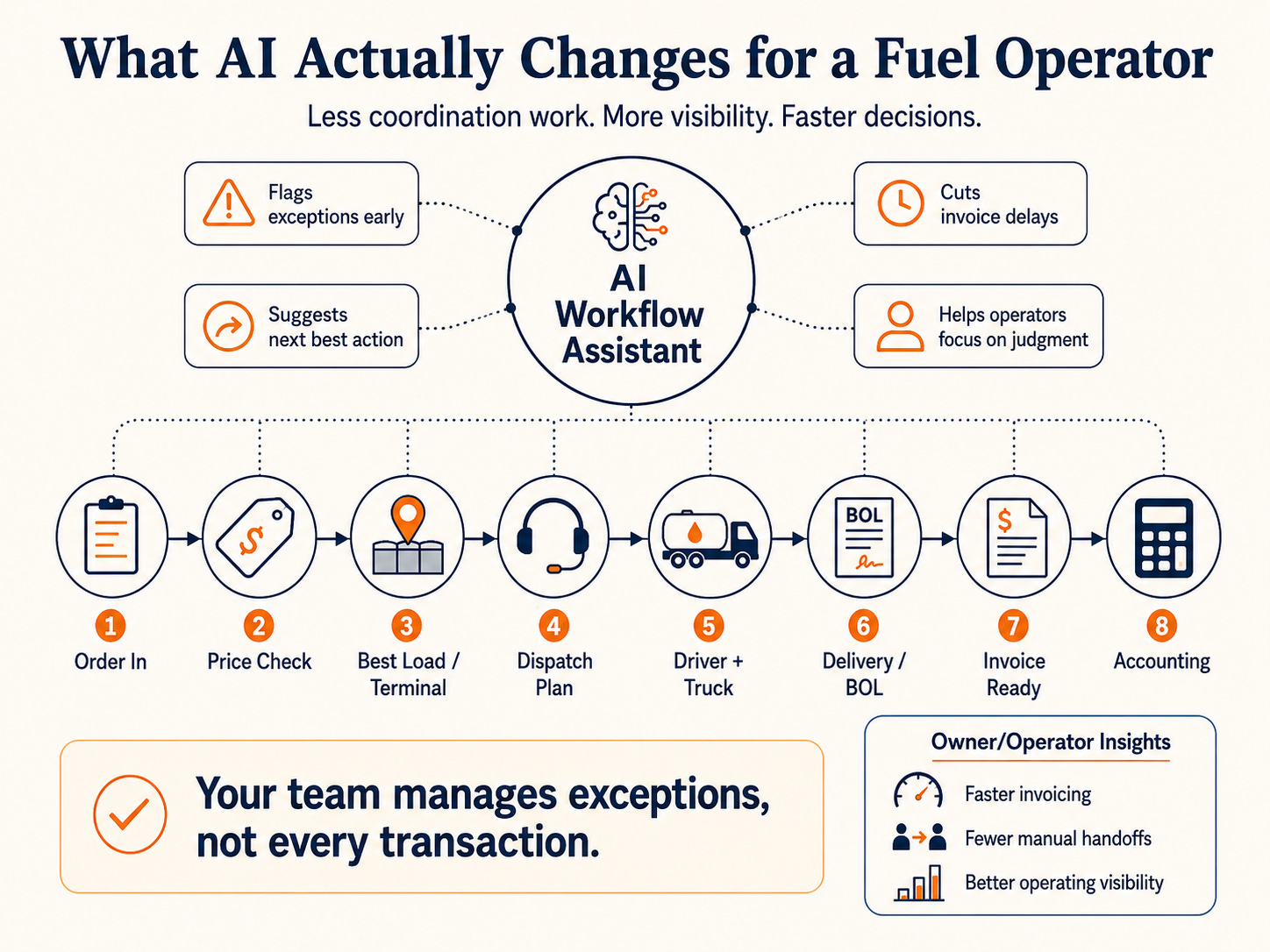
Someone takes an order. Someone checks the price. Someone figures out where to load. A dispatcher decides which driver and truck should run it. The driver gets instructions. The truck loads. A BOL comes back. The fuel gets delivered. Someone verifies the gallons. Someone creates the invoice. Someone checks the taxes. Someone gets it into accounting.
Then three days later somebody notices the supplier invoice does not match the BOL and the whole thing backs up while someone figures out why.
None of this work is complicated in isolation. Checking a price is not complicated. Matching a BOL is not complicated. Generating an invoice is not complicated.
The complication is that all of it has to happen in the right order, with the right information, for every single delivery, every single day.
That is coordination work. And coordination work is exactly where AI becomes interesting.
What AI is not going to do
Before I get into what I think changes, let me say clearly what I do not think happens.
AI is not going to replace your dispatcher. Not in the next five years and probably not ever in the way people imagine when they hear that word.
Your dispatcher knows things no software knows. Which driver can handle a difficult customer. Which terminal backs up on Monday mornings. Which customer always changes the order after the truck leaves. That knowledge took years to build and it does not live in any database.
AI is not going to make decisions that require judgment. It is not going to know that a customer is having a hard month and needs a call from the owner rather than an automated reminder. It is not going to know that a driver is dealing with something at home and should not be pushed on a tight route this week.
What AI is going to do is take the coordination work off the plate of the people doing the judgment work.
That is the real opportunity. Not replacement. Subtraction of the work that should never have required a human in the first place.
What that looks like in a fuel operation
Let me make this concrete because I think the abstract version of this conversation is what makes operators tune out.
Right now when a delivery closes, someone in billing has to gather the information to create the invoice. They pull the delivery record. They verify the gallons. They check the pricing agreement. They look up the tax treatment. They check whether the customer needs a PO number. They generate the invoice. They get it into accounting.
On a good day that takes a few hours for a full day’s deliveries. On a bad day, when tickets are missing or prices need to be verified or a customer has a special requirement nobody documented, it takes longer.
What if the invoice was ready three minutes after the delivery was confirmed?
Not because someone worked faster. Because the system already knew the pricing agreement, the tax treatment, the customer’s invoicing requirements, and the BOL matched the delivered gallons within tolerance. All the information was already there. The invoice generated automatically. Someone reviewed the exceptions. Everything else went straight through.
That is not science fiction. That is where the technology is heading and in some cases where it already is.
The dispatcher who manages exceptions instead of transactions
Here is another version of the same idea.
Today a dispatcher builds every route manually. They know which trucks are available. They know which drivers are on. They know the customer delivery windows. They know the terminal loading times. They hold all of that in their head or in a spreadsheet and they make dozens of small decisions every morning before the first truck rolls.
What if the system proposed the day’s dispatch plan automatically based on everything it already knows?
Not a rigid plan that cannot be changed. A starting point. A plan the dispatcher can review, adjust, and approve in fifteen minutes instead of building from scratch over two hours.
And when something goes wrong, because something always goes wrong, a driver calls in sick, a terminal goes down, a customer changes their order, the dispatcher is dealing with the exception from a position of clarity rather than trying to rebuild the entire day while fielding phone calls.
The dispatcher does not disappear. The transaction management does.
What is left is the judgment work. The work that actually requires someone who knows the operation.
What the billing team’s morning looks like
Same idea, different department.
Today a billing team reviews every transaction. Most of them are clean. A small number have issues. But because the system cannot tell which is which, every transaction gets human eyes.
Tomorrow the system handles the clean ones automatically. The billing team sees only the exceptions. The delivery where the gallons do not match. The invoice where the PO number did not arrive. The customer whose exemption certificate expired.
Instead of reviewing 300 transactions and finding 11 problems, the billing team sees 11 problems and resolves them.
That is a different job. A better job. And it produces faster invoicing, cleaner AR, and less end-of-month scramble because the exceptions were caught at the time of delivery rather than discovered three weeks later.
What I think the next few years look like
I am not going to pretend I know exactly how this unfolds. Nobody does.
But based on what I am seeing in the technology and what I know about how fuel operations work, here is my honest read.
In the next year or two the change is mostly about reducing the manual coordination work that slows billing, dispatch, and AR down. Invoices that generate automatically when all the conditions are met. Exceptions that surface to the right person at the right time. Supplier invoices that get matched automatically and flagged when they do not agree.
In the three to five year window the change gets more interesting. The system starts making recommendations that today require a person. Not final decisions. Recommendations. The pricing engine suggests the best terminal based on margin and availability. The dispatch system proposes the optimal route plan before the dispatcher starts their morning. The inventory system flags a replenishment need before anyone has to notice the tank level.
The operator is still making the call. They are just making it from a better starting position with better information.
The goal is not software that replaces the people running the operation. It is software that handles the routine so the people running the operation can focus on the things that actually require them.
The one thing I would tell any fuel operator reading this
The operators who will benefit most from what is coming are not the ones who rush to adopt every new AI tool.
They are the ones who take the time now to document how their operation actually works. The pricing rules. The customer requirements. The dispatch logic. The exception handling.
Because AI is only as good as the operational knowledge underneath it. A system that understands how your operation works can automate your routine. A system that does not understand your operation will create new problems faster than it solves old ones.
The knowledge Bob carries in his head about which terminals to avoid on Monday mornings is more valuable to an AI system than any algorithm. But only if it gets captured somewhere the system can use it.
That is the work worth doing now. Not evaluating AI platforms. Documenting what you know about your own operation before it walks out the door with the next retirement.
Next issue: Your fuel was delivered. Why is the invoice still not ready?cha