

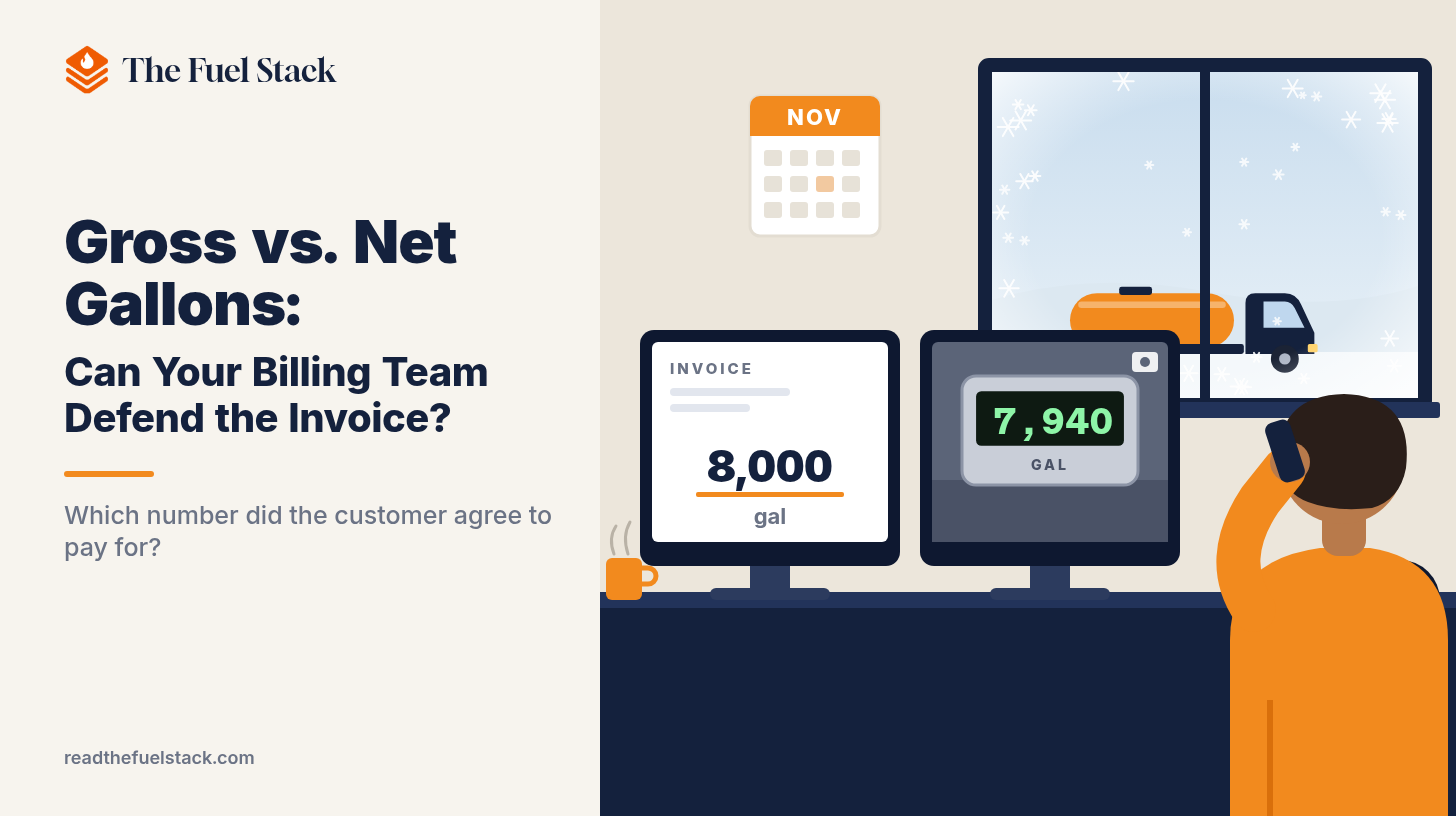
It's a Monday morning in November at a 12-truck jobber, and Rosa in billing picks up the phone. On the line is the controller at a fleet customer with forty trucks, an onsite tank, and a new fuel manager who reads the meter.
“Your invoice says 8,000 gallons. Our meter says 7,940. Which one are we paying for?”
Rosa knows the gap is probably temperature. She just can’t find anything that says whether this customer is billed gross or net. The agreement isn’t in front of her, and the customer record doesn’t say. So she does what a lot of billers do with a good customer on the line. She credits 60 gallons and moves on.
At $3.50 a gallon, that’s $210, small enough that it will never show up in a report. But the customer just learned that a phone call can move the number.
I don’t blame Rosa. She understood the physics fine. Nobody had given her anything to point to.
Your team knows the physics. Billing also has to be able to prove which number each customer agreed to pay for.
Your team already knows the difference
Gross is what the meter measured. Net is corrected to 60°F, so cold fuel bills higher on net than on gross. As a rough guide, Mansfield Energy puts the swing at about 0.7% for every 10°F, which on an 8,000-gallon load is roughly 55 gallons. Diesel moves a little less than gasoline. The argument is old enough to have its own court case, In re Motor Fuel Temperature Sales Practices Litigation.
The gap is that a lot of offices never wrote down the answer for each customer. These questions will tell you if yours did:
Is this customer billed gross or net, and for which products?
Where does that live? The contract, the customer record, or someone’s memory?
Does the delivery ticket carry the temperature, or just the meter reading?
Is the truck meter temperature compensated, and does the driver know?
In plenty of shops the honest answers are “depends on the customer,” “the biller knows,” and “ask Linda.” That holds up until Linda is on vacation during the first cold snap.
The same mismatch shows up on the buy side, when a supplier bills net against a BOL that captured gross. On the sell side it comes with a customer on the phone.
Why the calls start in the fall
Fuel temperature doesn’t track the outdoor thermometer exactly. But as the season turns, delivered fuel tends to run colder, and the gap between gross and net flips direction. Customers billed on net start seeing invoices that come in higher than their own meters.
Fleet accounts tend to notice first. They have a fuel manager, an onsite meter, and a controller who checks your invoice against their own records every month. You want customers like that. They’re also the ones most likely to find the rule you never wrote down.
What the credit costs you
The $210 is the least of it.
If you buy net at the rack and bill some customers gross, your margin swings with the season. In colder months you can end up billing fewer gallons than you paid for. That may be exactly what you agreed to. I’d just want someone to have decided it on purpose.
Credits also turn into policy. Once one biller credits a customer to end a call, the next one does the same, and before long it’s how you do business. Meanwhile, invoices sit while someone checks which number to use, which is one more cause of invoices that are delivered but not ready. Even when you were right, having to say “I’ll check and call you back” every winter wears on the relationship.
How to make the invoice defensible
You can fix most of this without new software. Start by writing down a handful of decisions where billing can find them.
Where you operate comes first, because the basis isn’t always your call. Many northern states lean toward gross and many southern states toward net, and state rules or fuel tax reporting can push you one way or the other. Confirm what applies to you first, then make sure every customer’s record and agreement match it.
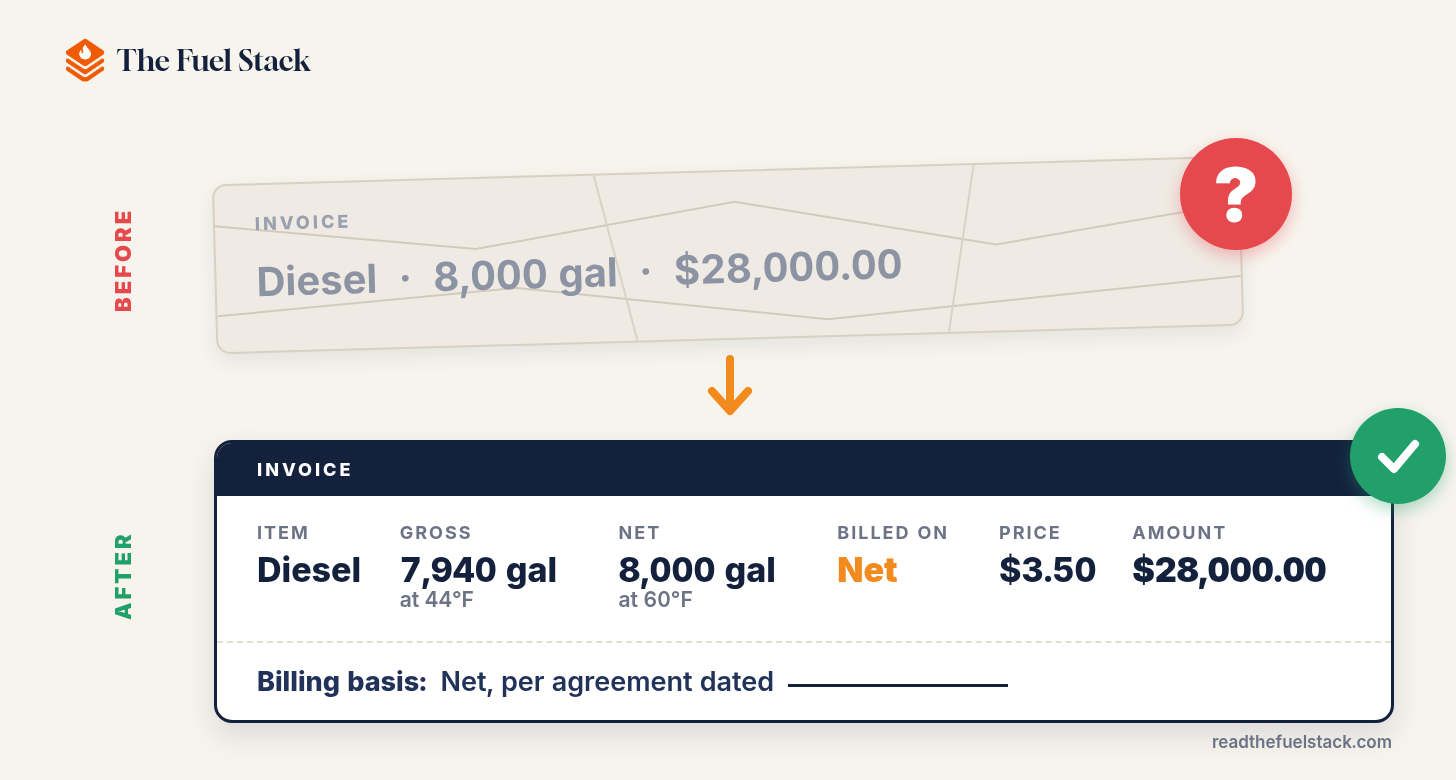
Put the billing basis, gross or net by product, on the customer record billing works from. If you bill net, have the temperature and correction travel with the delivery ticket so billing can show the math without calling the driver. Then let the invoice line show it:
Diesel · 7,940 gal gross at 44°F · 8,000 gal net at 60°F · billed on net
A controller who can see the math has much less reason to call.
Before the colder months, send your fleet accounts a short note on how you measure and why their invoices shift in winter. Set a simple rule for real disputes: what size difference gets reviewed, who can approve a credit, and what gets checked first. Track those credits as their own category so you can see whether they’re growing. Last, make sure whoever reviews margin can see buy basis and sell basis side by side.
Try it with five invoices
Pull five recent invoices for your biggest fleet customers. Ask someone in billing whether each customer is billed gross or net, and how they know. Then check the agreement.
If all five answers come back right, quickly, from a record anyone could find, you’re in good shape. If you hear “I think,” “it’s always been that way” or “let me ask,” you’ve found your next dispute before the customer did.
The fuel was measured correctly, and the invoice should be able to prove it.
Has a gross-versus-net question ever turned into a credit in your office just to end the call? Reply and tell me how it played out. I read all of them.
The jobber, the people and the numbers in this piece are illustrative. The problem is not.