

Last month I was sitting with a fuel marketer in Texas.
QuickBooks open on one screen. A spreadsheet on the other. A stack of delivery tickets beside the keyboard that billing had not gotten to yet.
I asked how long they had been on QuickBooks.
Nine years, she said.
I asked if they had ever thought about switching.
She laughed.
“We tried. Spent six months looking. Almost signed with someone. Then we looked at what migration would actually cost and what we would lose and we came back.”
She pointed at the spreadsheet.
“So now we have this.”
That spreadsheet is not unusual. It is the standard solution at mid-market fuel distributors across the country. Built by someone on the team. Maintained by that same person. Quietly holding the operation together in ways nobody fully documented.
QuickBooks is on the first monitor. The spreadsheet is doing the actual work on the second.
That is not a QuickBooks problem. That is a workflow problem wearing a QuickBooks problem’s clothes.
What QuickBooks is actually doing right
QuickBooks handles the accounting well. General ledger, accounts receivable, accounts payable, bank reconciliation, financial reporting.
For a fuel marketer who has been on it for years, that foundation matters. The team knows it. The bookkeeper knows it. The accountant can log in without a learning curve.
That is not nothing. That is years of knowledge embedded in a system that works.
The problem is not the accounting.
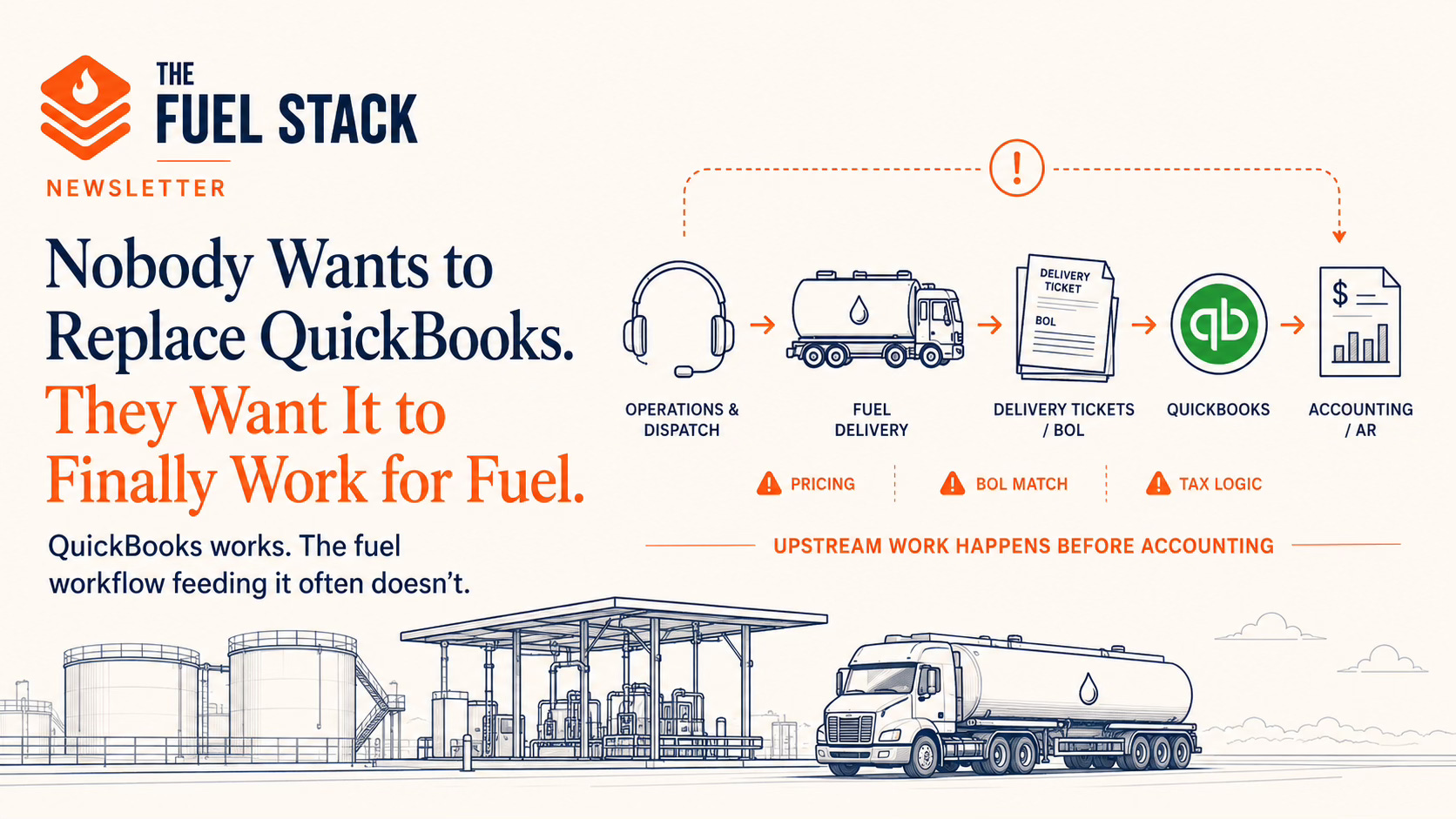
The problem is the ten steps between a fuel delivery and a clean transaction arriving in QuickBooks.
Rack price changes intraday. The next day rack starts coming in late afternoon. A delivery at 10am and a delivery at 3pm can carry different prices. Managing that correctly requires a system that understands rack timing.
Gallons are measured in gross at the terminal and net after temperature correction. Someone has to know which one the customer is being billed on.
The driver’s confirmation, the BOL, and the dispatch record all describe the same delivery. They all have to agree before billing can run.
Tax exemptions vary by customer, by site, by product type. They have to be applied correctly every single time.
QuickBooks was not designed to coordinate any of that. It was designed to record the result after it happens.
When a fuel marketer tries to use QuickBooks to manage that coordination, the billing team becomes the integration layer. They gather delivery data. Verify pricing. Apply exemptions. Enter the invoice. Every day. For every delivery.
That is why billing is broken. Not because QuickBooks is the wrong tool. Because it is being asked to do something it was never built for.
Why switching rarely fixes it
The instinct when billing breaks down is to blame the accounting system.
That instinct leads to ERP evaluations. New platforms that promise to handle everything in one place. Nine-month implementations. Budgets that grow. Go-live weekends where things break at midnight and the team works through it.
I wrote about Lisa in an earlier issue. She championed a full ERP implementation. Nine months. $240,000. Eighteen months after go-live, the spreadsheet was still open on the AP manager’s second monitor.
The ERP did not fix billing because billing was not broken inside the accounting system. It was broken in the ten steps before the accounting system ever saw the transaction.
Replacing QuickBooks does not fix the workflow that feeds QuickBooks. It just means you are managing the same broken workflow inside something more expensive and less familiar.
And you gave up eight years of financial history to do it.
The question worth sitting with
Before the next software evaluation, one question is worth asking honestly.
Is billing broken because of where the invoice gets recorded? Or because of how it gets created?
In almost every fuel operation I have visited, the answer is the second one.
The invoice gets created late, or wrong, or with errors, because the workflow between the delivery and the invoice is manual and disconnected. People are filling the gaps by hand because no system was built to fill them automatically.
Fixing that does not require a new general ledger. It requires an operational layer in front of the general ledger that handles the fuel-specific complexity QuickBooks was never designed for.
What that layer actually does
The problems that break billing upstream of QuickBooks are consistent across fuel operations.
Pricing. Rack changes intraday. The correct price at 10am is different from the correct price at 3pm. That has to be applied automatically, not looked up manually after the delivery happens.
Delivery confirmation. The driver confirms gallons. That confirmation should trigger billing immediately. Not sit in a queue until dispatch closes the load and billing pulls the ticket hours later.
Document matching. The BOL, dispatch record, and supplier invoice describe the same transaction. They need to agree before billing runs. In most operations they live in three different places and someone reconciles them at month-end.
Tax and exemption logic. A customer’s exemption status varies by site, by product, by monthly volume. That logic needs to live in the system. Not in someone’s memory.
None of these are accounting problems. They are operational problems that show up in the accounting system as billing errors and late invoices.
An operational layer that handles these problems upstream of QuickBooks does not replace the general ledger. It feeds it clean transactions instead of broken ones.
What this looks like in practice
Last year Fueleo processed over $5 million+ in invoices for our design partner customers with less than 1.45% sync error rate to QuickBooks.
Not in a demo. In a live operation. Real deliveries. Real customers. Real invoices syncing cleanly into an accounting system the team already trusted and did not have to replace.
QuickBooks stayed exactly where it was.
What changed was what arrived at QuickBooks before anyone in accounting touched it.
Delivery confirmation triggered billing automatically. Pricing was validated at dispatch, not reconstructed afterward. The BOL matched the dispatch record before the invoice was created. Tax exemptions were applied correctly based on the customer profile.
The accounting team went from spending hours gathering information to spending minutes reviewing exceptions.
That is not a new general ledger. That is a workflow that finally feeds the existing one correctly.
The decision that actually matters
Most fuel marketers do not need to replace QuickBooks.
They need to stop asking QuickBooks to do something it was never designed to do.
The general ledger is fine. The workflow feeding it is not.
Fixing the workflow does not mean tearing out the accounting system and starting over. It means building the layer in front of it that handles pricing, delivery confirmation, document matching, and tax logic before QuickBooks ever sees the transaction.
Smaller than an ERP implementation. Faster. Less expensive. No migration. No learning curve. No eight years of history lost.
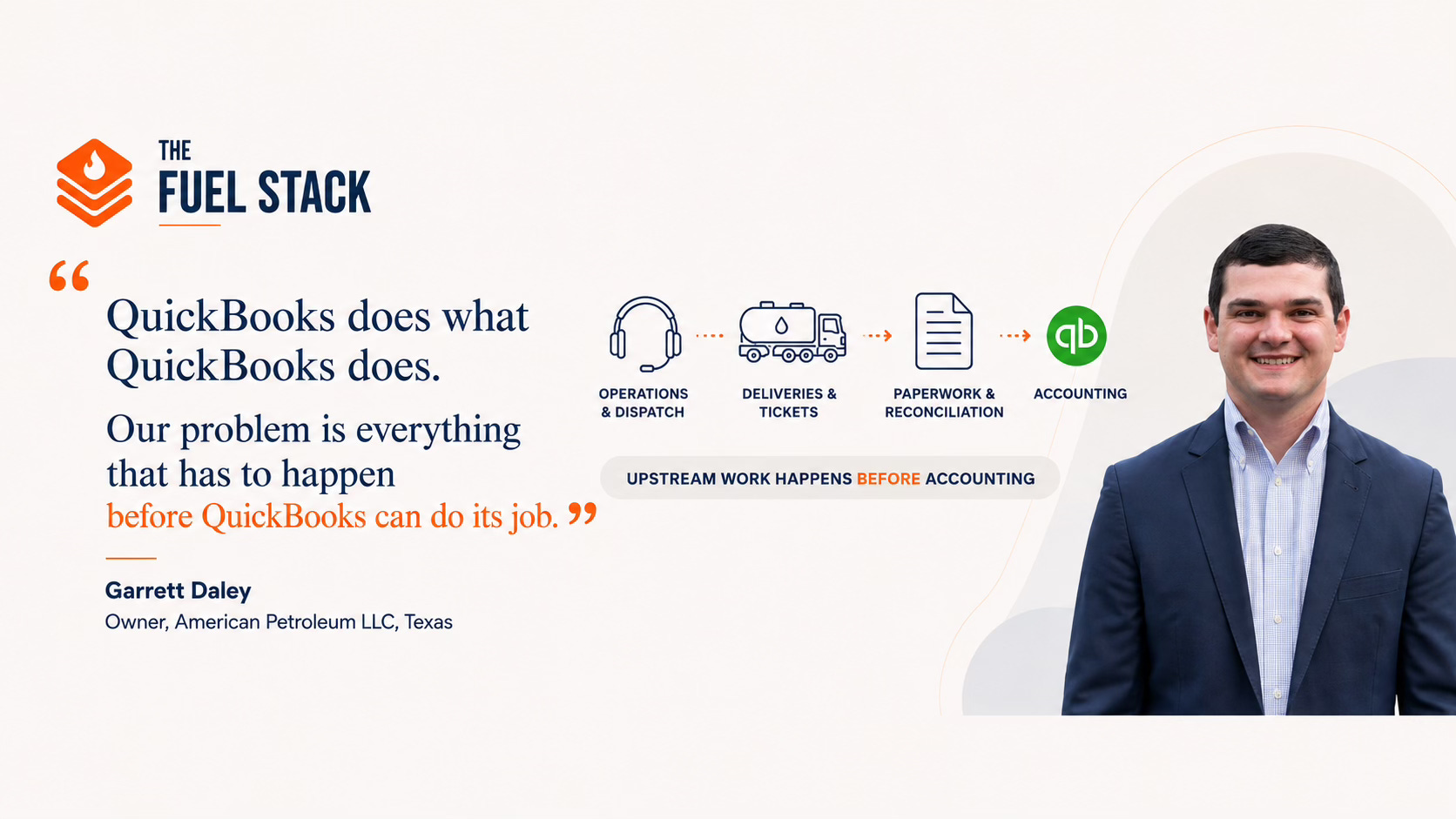
Garrett Daley, owner of American Petroleum, said it directly.
“QuickBooks does what QuickBooks does. Our problem is everything that has to happen before QuickBooks can do its job.”
He was right. And once he understood that, the decision about what to build became clear.
The accounting system was never the problem.
It was everything that had to happen before QuickBooks could do its job.