

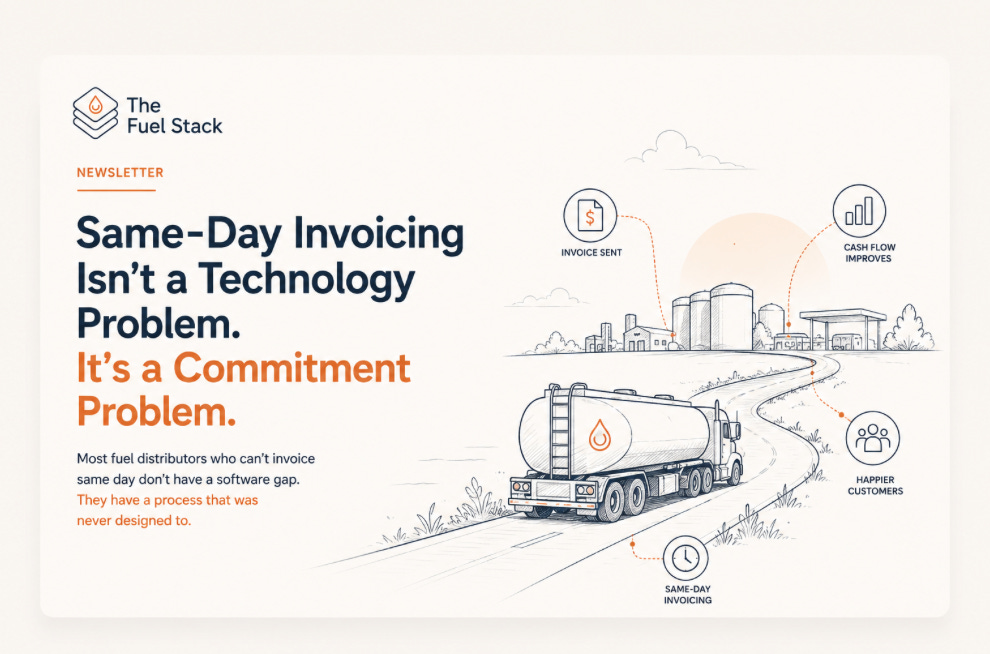
A truck delivers 4,200 gallons in the morning.
The driver has the ticket. Dispatch knows the load is done. The customer expects the invoice.
But billing is still waiting.
Waiting for dispatch to close the load. Waiting for the ticket to come in. Waiting for pricing to be checked. Waiting for someone to confirm that the invoice will not create a problem downstream.
That is how same-day invoicing dies.
Not in the software.
In the handoff.
Every fuel distributor I have talked to wants to invoice faster. Most of them cite the same barriers. The driver’s ticket comes in late. Dispatch hasn’t closed the load yet. Pricing needs to be verified before billing can run. The system doesn’t always sync cleanly with accounting.
All of those things are real. None of them are the actual reason same-day invoicing doesn’t happen.
The actual reason is simpler and harder to fix than any of them.
The process was never designed around same-day invoicing as a non-negotiable standard. It was designed around getting invoices out eventually, and eventually became the culture.
Same-day invoicing does not mean every invoice goes out blindly. It means standard deliveries move without unnecessary human delay, and true exceptions are separated from the normal flow.
What “eventually” actually costs
I wrote about this in the first issue of The Fuel Stack.
A mid-market distributor running 250 deliveries a month with a 3-day billing lag has roughly $95,000 in delivered-but-unbilled revenue sitting in limbo at any given moment. Across the year, $11.4M in revenue passes through a delayed billing workflow.
The exact number will vary by gallons, customer mix, fuel price, and delivery size. But the point does not change.
Delivered fuel that has not been invoiced is completed work still waiting to become collectible revenue.
That number is not an argument for faster software. It is an argument for a different commitment.
It is not sitting there because the software is slow. It is sitting there because the process was designed to let it sit there. Dispatch closes loads when they get to it. Billing waits for dispatch. Pricing gets verified after the fact. Every one of those steps has slack built into it, because nobody ever made same-day invoicing the standard that the entire process was built around.
When you build a process around “get it out as soon as we can,” same-day invoicing is a goal. When you build it around “the delivery is not complete until the invoice goes out,” same-day invoicing is an outcome.
Those are two different processes. Not two different software products.
The commitment question
The most useful question to ask about same-day invoicing is not “does our software support it?”
In many cases, the system is capable of producing the invoice faster than the organization is capable of trusting the workflow.
The useful question is:
Has the organization actually committed to same-day invoicing as a non-negotiable standard, and has the process been rebuilt around that commitment?
Those are two different things.
A lot of fuel distributors have expressed a preference for same-day invoicing. They would like it to happen. They have talked about it in operations meetings. Some have tried to push billing to move faster.
Very few have made it a standard in the way that changes how every upstream decision gets made.
A preference changes the goal. A commitment changes the process.
What a commitment to same-day invoicing actually requires
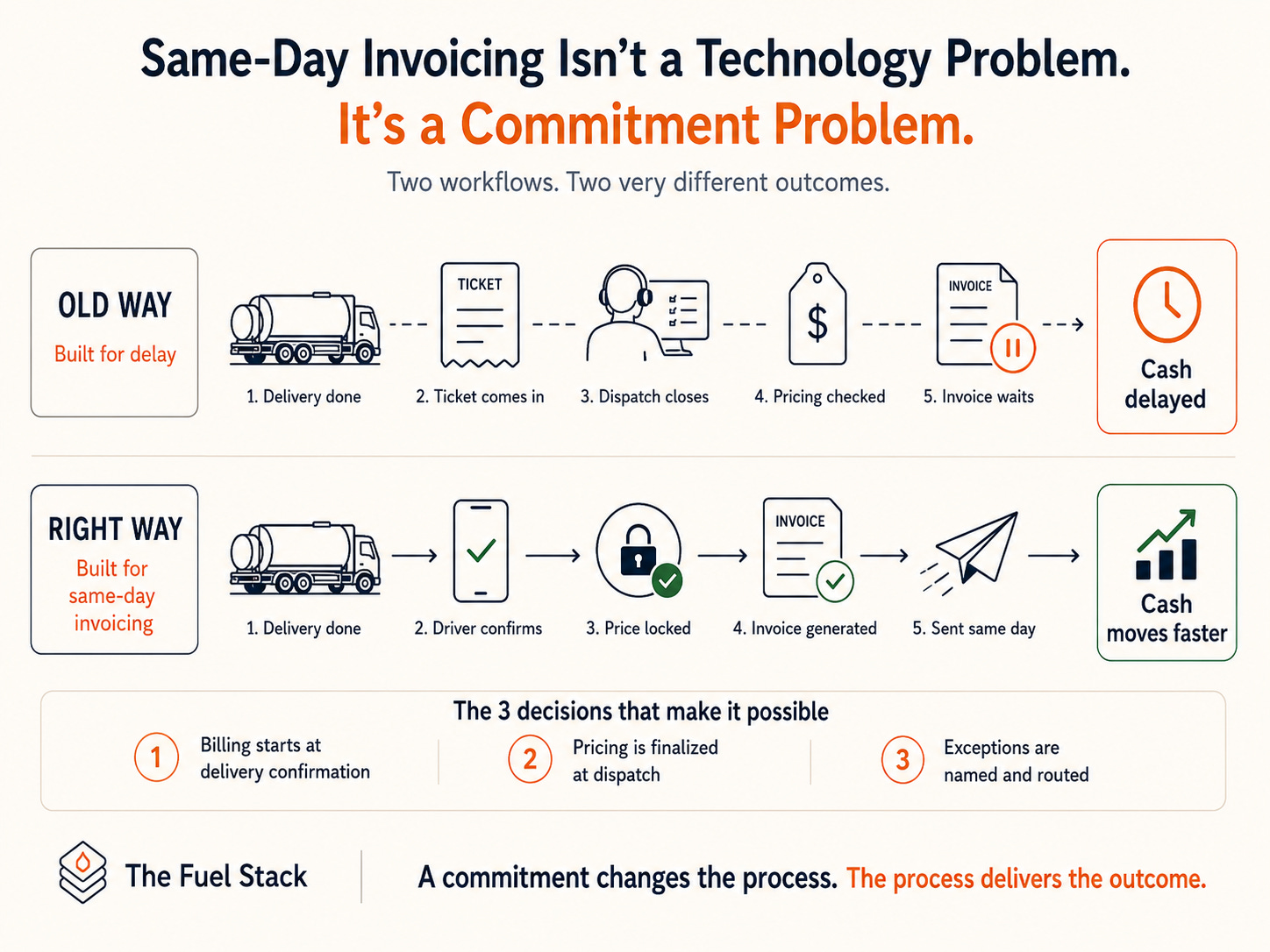
When same-day invoicing is a real standard, not an aspiration, it forces three upstream decisions that most fuel operations have never made cleanly.
Decision one: when does billing start?
In most operations, billing starts when dispatch closes the load. Dispatch closes the load when they get around to it, usually at the end of a busy dispatch window, or when someone reminds them, or when billing asks.
If billing starts when dispatch closes the load, same-day invoicing is hostage to dispatch’s schedule.
The real question is not whether dispatch has closed the load. The real question is: what event in the operation creates billing readiness?
In a same-day invoicing operation, billing readiness is not a mood, a reminder, or an end-of-day task. It is triggered by an operational event.
Delivery confirmation.
The decision that changes this: billing starts when the driver confirms the delivery. Not when dispatch closes the load. The delivery confirmation is the trigger. Dispatch close-out is a separate administrative step that happens in parallel, not in sequence before billing can move.
That one decision eliminates the most common single-point delay in the billing workflow.
Decision two: when is pricing finalized?
In most operations, the answer is: before the invoice goes out. Which means someone in billing is verifying pricing, checking contract terms, confirming rates, after the delivery has already happened.
That feels safe. It is also a workflow design choice that makes same-day invoicing structurally difficult.
In fuel, pricing is not a single number. It may include rack, margin, freight, surcharge, contract terms, product type, tax treatment, and customer-specific rules. If all of that is being reconstructed after delivery, billing is not invoicing. Billing is reverse-engineering the order.
The decision that changes this: pricing is finalized at dispatch, not at billing. The rate that goes on the load ticket is the rate that appears on the invoice. Billing does not rebuild the commercial agreement from scratch. It inherits a price that was already validated before the truck rolled.
If the price is wrong, you want to know before the driver leaves the terminal. Not after the delivery. Not when the customer calls. Before the truck rolls.
Decision three: what is an exception and what is a policy?
Every fuel operation has exceptions. Loads that get split mid-route. Customers who change delivery instructions after dispatch. BOL volumes that don’t match what was scheduled. Contract terms that are under review. Missing common carrier tickets. Freight discrepancies. Tax questions.
The question is whether those exceptions are genuinely rare, or whether they happen often enough that billing holds every invoice pending review just in case.
If billing reviews every invoice before it goes out because exceptions are frequent, the review step is not exception handling. It is the process. And a process that reviews every invoice before it goes out cannot invoice same day at volume.
The decision that changes this: trust the process for standard deliveries, and create a specific exception queue for the deliveries that genuinely need review.
A real exception queue should be specific: missing ticket, BOL mismatch, price conflict, gallons variance, tax issue, customer dispute, common carrier document missing, freight discrepancy.
If the reason cannot be named, it should not be allowed to hold the invoice.
Most invoices should clear without human review. The ones that don’t should be flagged automatically and handled as a small subset, not as the default.
If your exceptions are common enough that reviewing every invoice feels necessary, the exceptions are not the problem. The process that creates them is.
Same-day invoicing is a trust test
Same-day invoicing is ultimately a trust test.
Does billing trust the delivery data? Does billing trust the price? Does accounting trust the sync? Does the customer trust the invoice?
If the answer is no, the invoice waits.
The solution is not to tell people to move faster. The solution is to make the upstream workflow trustworthy enough that waiting is no longer necessary.
That is why same-day invoicing is such a useful operating standard. It exposes every weak handoff before billing.
If tickets are late, it shows up. If pricing is unclear, it shows up. If contract terms live in someone’s head or in a spreadsheet nobody fully trusts, it shows up. If accounting sync issues create duplicate invoices, it shows up.
Same-day invoicing does not create those problems. It reveals them.
Why technology keeps getting blamed
When same-day invoicing doesn’t happen, the instinct is usually to look at the software.
The dispatch system doesn’t integrate well enough with billing. The driver app doesn’t push data in real time. The accounting sync creates duplicates. The pricing module can’t handle the contract complexity cleanly enough to be trusted without a manual check.
All of those things can be true. Better software helps. Integration reduces friction. A driver app that confirms deliveries in real time and pushes data directly to billing eliminates a whole category of delay. A pricing system that handles rack, margin, freight, surcharge, contract terms, tax rules, and customer-specific logic reduces the need for manual review.
But here is what software cannot do.
Software cannot make same-day invoicing a standard if the organization has not committed to it as one.
A better dispatch integration speeds up the handoff between dispatch and billing. But if dispatch’s culture is still to close loads at the end of the day when things settle down, a faster integration just moves slow data faster.
A driver app that confirms deliveries in real time eliminates the ticket-comes-in-late problem. But if billing is still waiting for someone to manually verify pricing before the invoice runs, real-time delivery confirmation doesn’t change when the invoice goes out.
The technology upgrades are real. The efficiency gains are real. But they are downstream of the commitment.
The commitment has to come first. The technology serves the commitment. It cannot substitute for it.
The operators who have figured this out
The fuel distributors invoicing same day consistently are not all running the same software.
Some are running QuickBooks. Some are running mid-market ERPs. Some are using purpose-built fuel distribution platforms. The software varies. What doesn’t vary is the operating model.
Most operations move through three stages.
Stage one: invoices go out when billing catches up.
Stage two: invoices go out faster because people push harder.
Stage three: invoices go out same day because the workflow was designed that way.
The mistake is thinking stage two is transformation. It is not. It is pressure. Stage three is the operating model.
And critically, the operators who have figured this out measure it. Not anecdotally. Not by feel. They know their same-day invoice rate. They know their dispute rate. They know which customers, which drivers, which product types, and which delivery workflows create billing delays or errors.
What gets measured gets managed. What gets managed gets done consistently.
The question that actually matters
Before the next conversation about invoicing software, billing systems, or dispatch integrations, one question is worth asking internally.
Has the organization actually committed to same-day invoicing as a non-negotiable standard?
Not “do we want to invoice faster.” Not “can our software support it.” Has the commitment been made, and has the process been rebuilt around it?
If the answer is no, the software conversation is premature.
Better software on top of a process designed around “eventually” produces faster “eventually.” It does not produce same-day.
Same-day invoicing is not proof that the billing team worked harder. It is proof that dispatch, pricing, delivery, billing, and accounting were designed to work as one flow.
The commitment has to come first. Once it does, the process questions become clear, the technology decisions become obvious, and same-day invoicing stops being a goal that keeps getting pushed back and starts being the way the operation actually runs.
It is not a technology problem. It is a commitment problem. And commitment problems do not get solved in a software demo.
Next issue: The Garrett Daley conversation. American Petroleum’s owner on customer obsession, the fleet account he lost on the invoice, and what same-day invoicing looks like as a living operating standard.
About the author
I’m Dibyesh G., founder of Fueleo. I spend my time working with fuel marketers on the messy handoffs between pricing, dispatch, delivery, BOLs, invoicing, inventory, and accounting. This newsletter is where I write about the operational problems hiding inside everyday fuel workflows.
Really enjoyed this perspective.
One thing I’ve observed working with fuel suppliers across diverse markets is that the gap between delivery and invoicing is rarely solved by technology alone. I’ve seen organizations operating on legacy DOS-based systems produce reliable results, while others with modern integrations and near real-time visibility still struggle with execution.
The common denominator wasn’t the software.
The suppliers that consistently produced accurate, timely invoices typically had strong operational processes, clear accountability, and disciplined execution. Technology accelerated performance, but process ownership made it sustainable.
In many cases, the biggest improvements came from connecting dispatch, delivery, billing, and customer communication into a workflow that people actually followed.
Appreciate you highlighting that same-day invoicing is as much an operational challenge as it is a technology challenge.