

Six-thirty in the morning, and the first thing Danny does after climbing into the cab is check his phone signal.
One bar. Maybe two, depending on where the truck is parked. It is not going to get better once he is on the route, not in the stretches between stops where the cell towers thin out and the app spins on a loading screen that never quite finishes.
He has been driving for a fuel distributor in the Southeast for six years. The company rolled out a driver app eighteen months ago. Real-time delivery confirmation, signed delivery tickets, rack BOL photos, GPS-stamped timestamps, all of it flowing straight into billing. On paper, exactly what billing needed to stop waiting three days for a paper ticket to make its way back to the office.
Danny still carries a paper ticket book in the truck door.
Not because anyone told him to. Because by his second week with the app, he had already learned the things nobody mentioned in training.
What the app actually requires of him
A delivery for Danny looks like this. Pull into the site. Find the right tank, because not every customer labels them clearly and not every drop is a single tank, sometimes it’s a split drop across two or three tanks from the same compartment. Connect the hose. Start the pump. Watch the meter while it runs, because customers notice if you are looking at your phone instead of the tank.
Somewhere in there, the app wants him to confirm the customer, the product, the tank, the compartment, the starting meter reading, the ending meter reading, the gallons delivered, and whether the drop matched what dispatch actually sent him out for, because sometimes a stop changes mid-route and the order on his phone doesn’t match what the customer is asking for when he pulls in.
He is wearing gloves most months of the year. The touchscreen does not reliably register a gloved finger, so the gloves come off, which means cold hands in winter and the gloves get set down somewhere, usually on top of the tank or the truck step, where they sometimes get forgotten.
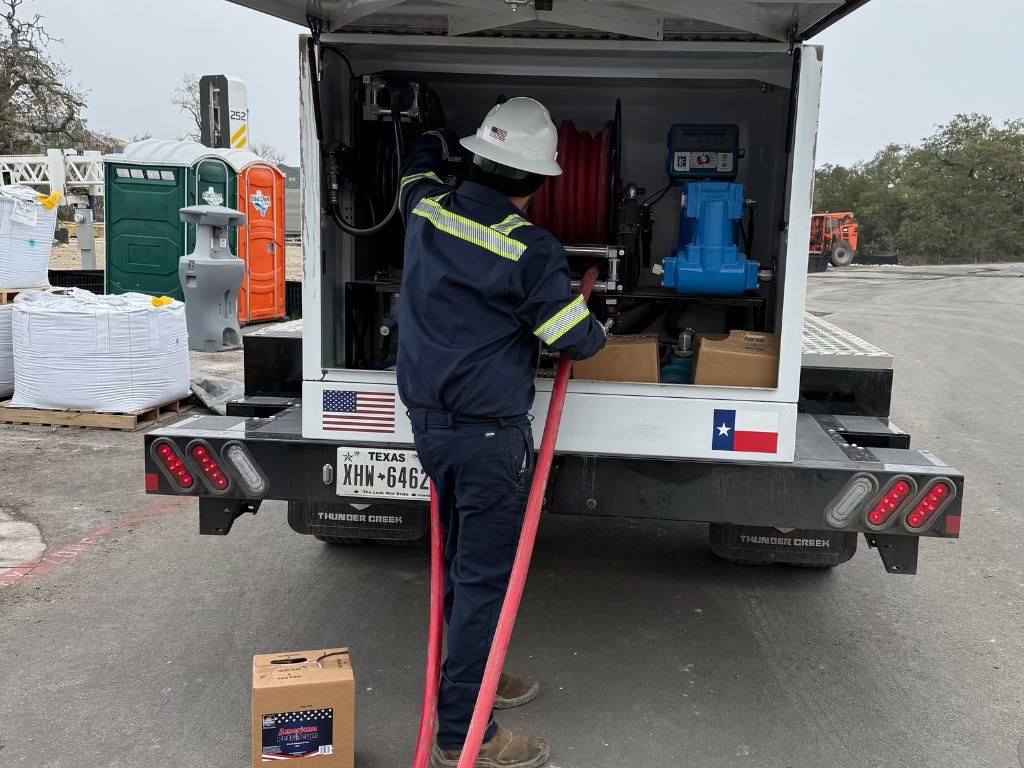
The screen is hard to read in direct sun, which is most of his working day. He has learned to angle his body to throw a shadow over the phone just to see what he is tapping.
And if the signal drops mid-entry, which happens at a meaningful number of his stops, the app does not always save what he has entered. Sometimes it does. Sometimes he gets to the next stop and finds the previous delivery sitting in a queue, unsynced, with no clear indication of whether it actually went through.
None of this is a single dramatic failure. It is friction. Thirty seconds here. A minute there. Multiplied across eight to twelve stops a day, it adds up to real time, and more importantly, it adds up to real doubt about whether the app actually captured what happened.
Why the paper ticket survives
The paper ticket does not require a signal. It does not care about gloves. It does not have a loading screen.
Danny writes the numbers down because he trusts what he can see with his own hand on a piece of paper more than he trusts an app that has eaten an entry before. If the app captures the delivery cleanly, great, that is one less thing he has to think about. If it does not, the paper ticket is the backup that makes sure the customer gets billed correctly and he does not get a call from dispatch asking where a load went.
Paper survives because it is reliable, not because drivers are nostalgic.
Over time, the backup became the primary, and the app became the thing he updates when he remembers and has signal.
He is not being defiant. He is doing what any reasonable person would do when a tool fails them often enough: he stopped trusting it as the only system of record and built a workaround that he controls.
In one of my conversations with Stephanie McAnally, a seasoned C-suite leader in the fuel industry, she said something that reframed how I think about this.
“My drivers do their work diligently. They do the paperwork before and after delivery. They make sure it is correct. So if they are resisting a driver app, I don’t see that as a driver problem. I see it as an adoption problem.”
That distinction matters.
A driver who has spent years doing paperwork correctly, loading accurately, delivering cleanly, and making sure the numbers match before handing in the ticket at the end of the shift is not someone who doesn’t care about getting it right. That driver has already proven they care about getting it right. The paper process earned their trust over years of consistent, reliable use.
When that same driver resists an app, the question worth asking is not “why won’t they change” but “what did the implementation process miss?”
Drivers resist when the new workflow creates doubt where the old one created confidence. That is not a driver failure. That is a signal that the technology wasn’t introduced in a way that earned the same trust the paper process had already built.
The only way to close that gap is for the technology to be developed and implemented with every stakeholder involved. Not handed down. Not rolled out in a training session. Built around the actual workflow the driver lives in, tested in the field, and refined until the driver’s natural instinct is to reach for the app the way they used to reach for the ticket book.
Technology changes workflows. Trust drives adoption.
This is the part that almost never gets surfaced back to the people who bought the app. Nobody in the back office sees Danny’s paper ticket book. They see the app’s adoption dashboard, which shows him logging deliveries most days, just with gaps, just with timestamps that sometimes don’t match when the delivery actually happened, just with entries that were backfilled from memory at the end of a long shift using the paper numbers as reference.
The dashboard says adoption is around 70%. What it does not show is that 70% adoption with frequent backfilling is not the same thing as 70% of deliveries being captured accurately at the point of delivery, which was the entire reason the app got bought.
Where this actually costs money
This is not just a story about a frustrated driver and a clunky app.
The cost is delayed invoicing. Disputed gallons because the meter reading entered into the app doesn’t match what’s on the paper ticket, and now someone in billing has to figure out which number is correct before the invoice can go out. Billing staff calling drivers to confirm a delivery that should have already been confirmed automatically. Dispatchers reconstructing what happened on a route because the app shows a gap and nobody remembers the details three days later.
In fuel, bad field data does not stay in the field. It moves downstream into billing, margin, inventory, and customer trust.
The natural fix to the driver-as-data-entry-clerk problem is a driver app. But that fix only works if drivers actually trust and use it the way it was designed. If the app gets used inconsistently, with paper as a silent backup, the original problem has not been solved. It has been relocated, and now there are two records to reconcile instead of one.
Where driver apps actually fail
This is not a story about drivers resisting technology. Most drivers, including Danny, would genuinely prefer a tool that worked reliably over a paper ticket book that gets soggy in the rain and has to be physically transported back to the office.
The failure is almost always in the gap between how the app was designed and how a delivery actually happens in the field.
Screens designed for office fingers, not diesel gloves. Most fuel distribution driver apps were not purpose-built for the conditions drivers actually work in. They were adapted from generic field service or delivery software, with input methods that assume a controlled environment.
Connectivity assumptions that don’t match rural and industrial delivery routes. A meaningful share of fuel deliveries happen at sites with poor cellular coverage. Industrial yards, rural agricultural operations, wet hose jobs where the driver is moving asset to asset, not tank to tank. An app that requires a live connection to confirm a delivery is an app that will fail at exactly the locations where reliable data capture matters most.
Forms that ask for ten fields while the driver is watching a meter, managing a hose, and trying not to block the customer’s yard. Every additional required field is an additional point where the driver either slows down significantly or starts entering placeholder data just to get past it.
No clear signal of what happened to an entry. When a driver submits a delivery and the app does not clearly confirm it was received and synced, the driver has no way to know whether the data made it anywhere. That uncertainty is what brings the paper ticket back as a hedge.
What actually changes adoption
The fuel distributors who get real adoption, not dashboard adoption, but drivers genuinely trusting the app as the system of record, tend to have solved a narrower set of problems than the feature list on most driver app sales decks would suggest.
The app works offline and syncs when signal returns, without losing data or creating ambiguity about whether an entry went through. This single fix addresses the root cause of most paper-ticket-as-backup behavior. If a driver can trust that an entry made with no signal will sync correctly later, the entire reason for keeping a parallel paper system disappears.
The interface is built for the conditions, not adapted to them. Larger touch targets that work with gloves. High contrast displays readable in direct sunlight. Minimal required fields for a standard delivery.
Confirmation is immediate and unambiguous. The driver sees, clearly, that the delivery was captured. Not a spinning icon. A confirmation that removes the doubt that drives backup behavior.
The data the driver enters is the data billing uses, with no second transcription step. If drivers know their entry goes directly into billing and inventory with nobody re-keying it later, the app feels like it matters. If they sense someone in the back office will double check their entry against a paper record anyway, the incentive to be careful erodes.
Adoption is not a training problem. It is a trust problem. Drivers will use a tool reliably the moment they trust it more than the alternative they already know works.
The metric that actually matters
Most fuel distributors measure driver app success by login frequency or entries per day. Those numbers can look healthy while the underlying problem, accurate data capture at the point of delivery, remains unsolved.
A better metric is delivery-to-sync time: the time between the actual delivery completion and when clean delivery data is available for billing, inventory, and customer documentation.
If a stop was completed at 10:15am but entered at 4:40pm, that is not real-time capture. That is end-of-day reconstruction wearing a digital costume.
Another honest metric is the rate of manual correction. How often does someone in billing or dispatch have to adjust, override, or cross-reference an app entry against some other source. A high correction rate, even alongside high login frequency, means the app’s data is not trusted internally either, which mirrors exactly what is happening with the driver in the field.
Four questions worth asking about your own driver app
A driver app that actually replaces paper has to answer four questions clearly.
Can the driver complete the stop with no signal?
Can the driver see exactly what is saved, synced, and still pending?
Can billing invoice from that entry without re-keying anything?
Can exceptions be separated out without holding up the clean tickets behind them?
If the answer to any of these is no, the paper ticket is still doing the real work, no matter what the adoption dashboard says.
Danny still keeps the paper ticket book in the truck door. He still puts gloves on and off a dozen times a day. He still loses signal in the same three spots on his route, every single day.
Nobody designed the app to fail him specifically. The people who built it had never stood at a tank with cold hands trying to read a phone screen in direct sun, managing a hose, watching a meter, all while a customer waited.
What Stephanie said is the right frame for all of it. Danny’s drivers do their work diligently. They always have. The paper process earned their trust over years. The app hasn’t earned it yet.
That is not a driver problem. That is an implementation problem. And the only way to fix it is to build and roll out the technology the way trust is actually built, with the people who have to use it, around the workflow they actually live in, until reaching for the app feels as natural as reaching for the ticket book.
Technology changes workflows. Trust drives adoption.
The question worth asking this week
Pull the adoption dashboard for your driver app. Then pull a sample of delivery timestamps and compare them to when the deliveries actually happened, if you have any way to verify that independently.
If there’s a meaningful gap, you don’t have an adoption problem. You have a trust problem, and the dashboard is hiding it.
Ask one driver, off the record, whether they still carry a paper backup. The answer will tell you more than any usage report
About the author
I’m Dibyesh Giri, founder of Fueleo. I spend my time working with fuel marketers on the messy handoffs between pricing, dispatch, delivery, BOLs, invoicing, inventory, and accounting. This newsletter is where I write about the operational problems hiding inside everyday fuel workflows.
Great perspective Dibyesh,
One thing I've observed across fuel, equipment rental, and other operational businesses is that technology often gets the credit when projects succeed and the blame when they fail.
In reality, adoption is usually the deciding factor. The most sophisticated system in the world creates little value if the people using it don't trust the process, understand the benefit, or see how it helps them do their job better.
The organizations that seem to get the most from technology are often the ones that invest just as much effort into communication, accountability, and trust as they do into the software itself.