

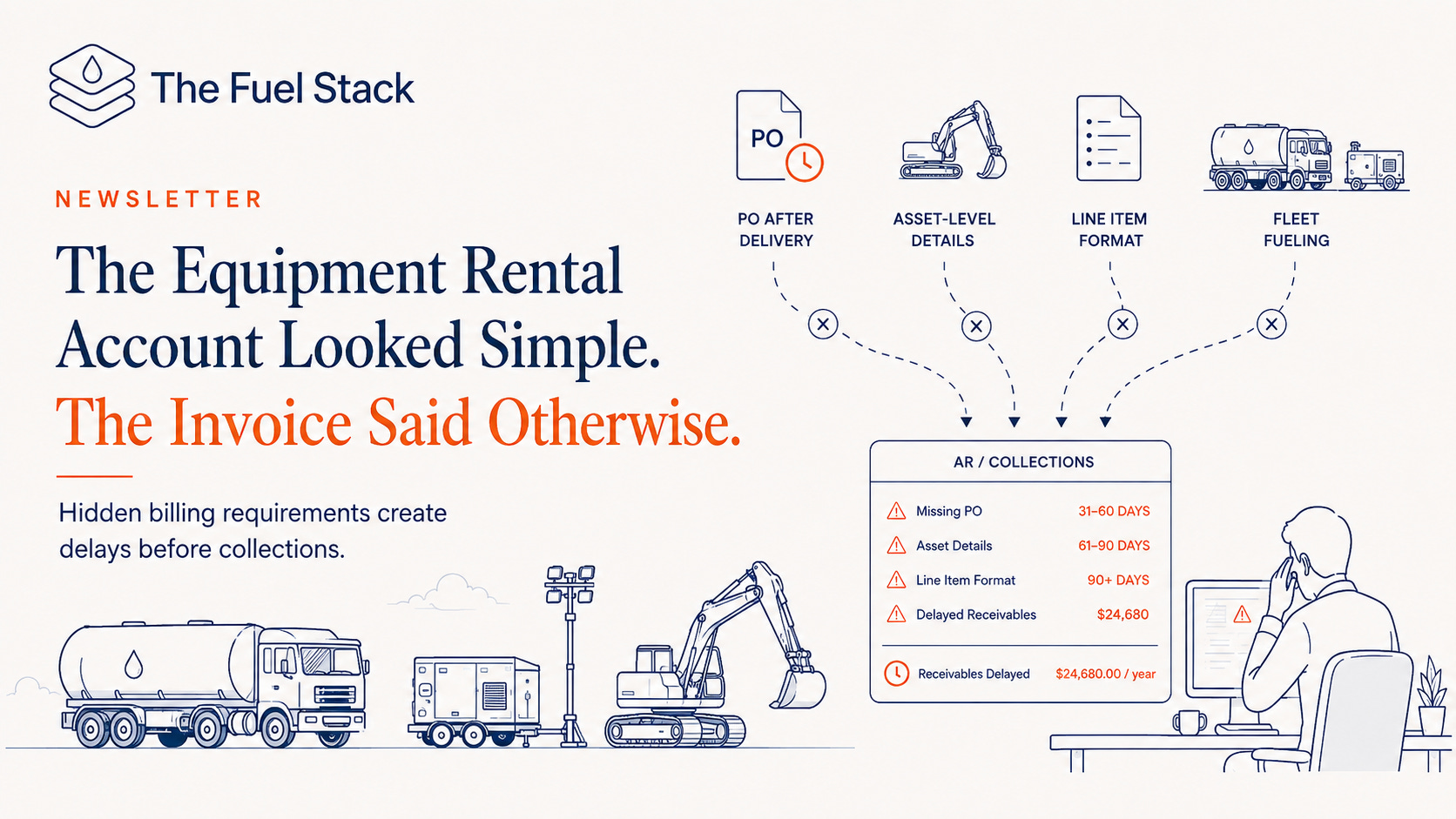
I have talked to enough fuel marketers serving equipment rental companies to know how this conversation usually goes.
The sales call goes well. The account looks clean. Rental company needs fuel delivered to their job sites. Fuel marketer shows up, delivers, sends an invoice. Rental company pays, marks up the fuel to their customer, everyone moves on.
That is the story in the sales meeting.
Here is what happens after the first delivery.
The invoice goes out. Then the PO arrives.
The sales call goes well. The account looks clean. Rental company needs fuel delivered to their job sites. Fuel marketer shows up, delivers, sends an invoice. Rental company pays, marks up the fuel to their customer, everyone moves on.
That is the story in the sales meeting.
Here is what happens after the first delivery.
The invoice goes out. Then the PO arrives.
The driver delivers. Everything goes right. Gallons match. Ticket is legible. Invoice goes out same day.
Then the rental company’s AP team responds.
Not with payment. With a PO number.
A purchase order their team generated after the delivery, which needs to appear on the invoice before their system will touch it.
Billing pulls the invoice, adds the PO, regenerates, resends.
The delivery was right. The invoice was right. The only thing missing was a number that did not exist when the invoice was created.
Payment terms do not start until the corrected invoice lands in AP.
Let’s say you have five equipment rental accounts. Each averages fifteen deliveries a month at $2,500 per invoice.
That is 75 invoices a month. $187,500 in monthly receivables.
If every invoice requires a PO correction cycle that adds three days before payment terms start, you are carrying $18,750 in delayed receivables every month before the customer has even looked at the invoice.
That is $225,000 a year sitting in a correction queue.
Not because customers are not paying. Because the invoice was not ready to be paid.
Not a collections problem. A workflow problem that shows up in the aging report.
Why this happens specifically with rental companies
Most fuel distribution customers generate PO numbers before the order is placed. The PO exists when the order is created. Invoice references it. Done.
Equipment rental companies work differently.
Their fuel subcontracting is operationally driven. A site manager decides machines need fuel. They call the rental company. The rental company calls the fuel marketer. The fuel gets delivered. Procurement catches up afterward.
What most fuel marketers do not realize is that the rental company is not just passing the invoice through. They are marking up the fuel and billing it to their own customer as an ancillary revenue line.
A delayed or incorrect invoice from the fuel marketer does not just slow their payment. It delays their invoice to their customer too.
The problem travels upstream.
The line item problem nobody mentions
Equipment rental companies need fuel cost and delivery charge as separate line items for their own tax treatment.
If the fuel marketer sends one combined line, the AP team has to split it manually before they can process it.
One more invisible step. One more reason the invoice takes longer to move.
The asset detail request
The fuel marketer delivered 800 gallons to a construction site.
But the rental company needs to know how many gallons went into the excavator, how many into the generator, how many into the light tower.
Not because they are being difficult. Because they already track every hour of use on every piece of equipment they rent and bill their customers at the asset level. Fuel is one of twelve revenue streams in a rental operation and each one has its own billing logic.
The fuel marketer is the only vendor not delivering data at that level of detail.
The driver delivered to a site. He did not track by asset. The ticket shows total gallons at a location. Someone now has to reconstruct the breakdown from memory or make an estimate.
All three problems share the same root cause
The billing requirements were never captured before the first truck rolled. They were discovered through rejection.
Every equipment rental account is different. But the fix flows in the same direction every time.
The PO requirement needs to be captured at account setup, not discovered at invoice rejection. If this customer generates PO numbers post-delivery, the invoice should sit in a billing-ready state until the PO is collected. Not sent blank and corrected later.
The asset-level detail needs to flow backward into dispatch before the driver arrives. If the rental company needs gallons by asset, the dispatch record needs the asset list before the driver arrives at the site, not just the address. The driver records gallons by asset at the point of delivery. Not reconstructed afterward from memory.
The line item format and compliance requirements belong in the account profile at setup. Every document the customer needs, every format requirement their AP team has, every certification a site requires, should be visible to billing and dispatch before the first delivery happens.
None of these are complicated fixes. They all require one thing:
Billing requirements flowing backward into the dispatch workflow instead of being discovered forward through invoice rejections.
The question nobody asks in the sales conversation
Walk me through how your AP team processes a fuel invoice.
That one question surfaces the PO requirement, the line item format, the asset-level data expectation, and the compliance documentation before the first delivery. The account works the way the sales conversation described.
Wait until the first invoice comes back and you are three weeks into a correction cycle that was entirely avoidable.
The equipment rental company is a good account. The happy path is real. You just have to ask about the other path before you start driving.