

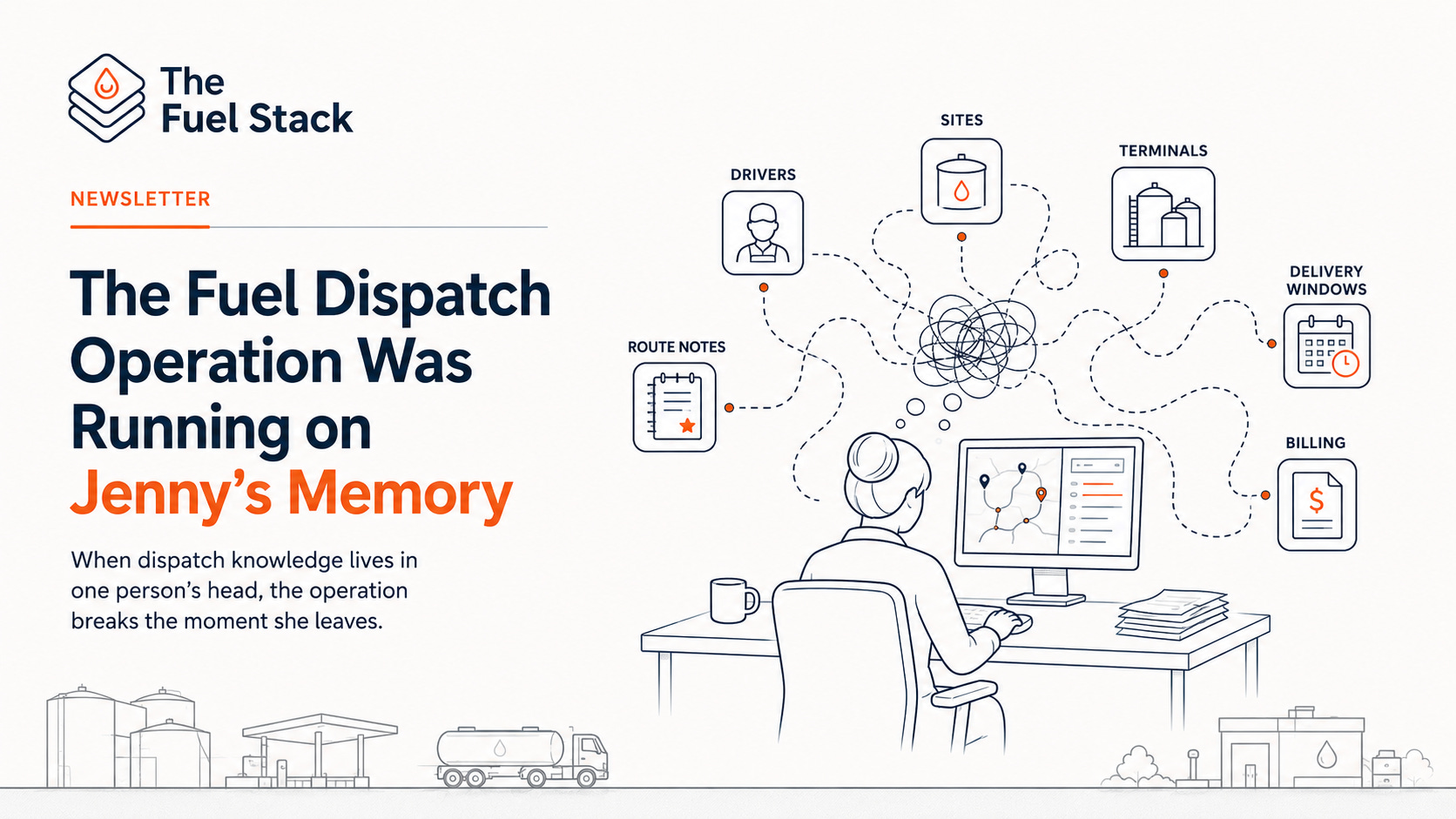
In fuel distribution, dispatch is not just putting trucks on a schedule.
It is where customer promises, driver judgment, terminal constraints, delivery windows, and billing consequences all meet.
Jenny had been dispatching for the same petroleum distributor in Eastern Washington for fourteen years.
She knew every driver by name, by habit, and by the way each one sounded when something was about to go wrong on a route.
She knew which driver could handle a tight downtown delivery without getting frustrated. She knew which driver preferred certain routes because he understood the sites better. She knew which customers needed a call before the truck arrived. She knew which roads flooded in March. She knew which site had a gate code that changed every few months but never made it into the system.
She knew which terminals moved fast in the morning and which ones backed up by noon.
She knew which customer would complain if the delivery happened after 6am because their yard became too congested.
She knew which wet hose account had equipment spread across three lots even though the order only showed one address.
She knew which driver needed a warning before going to a difficult site.
And she knew the little dispatch decisions that prevented bigger problems later in billing, customer service, and operations.
None of this was documented.
It was just known. Because Jenny knew it.
The company threw her a retirement party on a Friday in October. Cake. A card signed by everyone. A gift card to a place she liked. Her manager gave a speech about what she meant to the operation.
Three weeks later, dispatch started breaking.
What breaking looks like in fuel dispatch
It did not happen all at once.
That is the thing about losing dispatch knowledge. It rarely shows up as one dramatic failure. It shows up as friction across the day.
A driver called from a customer site with a question about the tank setup. Jenny would have known the answer immediately. The new dispatcher searched the system, found nothing useful, called the customer’s main office, and waited.
The driver sat for twenty minutes.
That twenty minutes did not stay isolated. It pushed the next stop. It changed the route. It created another customer call. It made the driver irritated. By the end of the day, one missing site note had become a dispatch problem, a customer service problem, and a driver morale problem.
Another customer complained that the truck arrived too late. The new dispatcher had scheduled the delivery at 9am because, on the route board, that made the most sense.
But Jenny had always known this customer needed delivery before 6am. Their yard became too busy after that. The truck blocked movement. The customer’s team got frustrated.
It was not a written rule. It was a dispatch rule Jenny had carried in her head for years.
The system showed an address. Jenny knew the operation behind the address. That is the difference.
The third week, a pricing exception that had been applied manually every month for three years was missed. Not because anyone was careless. Because the exception lived in Jenny’s head, attached to no record anyone else could find, applied correctly every single month for years by a person who was no longer there.
The fourth week, the operations manager sat down and tried to write down everything Jenny knew. He got through about a third of it before he realized he did not actually know what he did not know.
Dispatch is where hidden rules live
In fuel distribution, dispatch is not just a calendar.
Real dispatch is full of hidden rules.
Customer delivery windows. Tank access instructions. Driver-site fit. Terminal preferences. Branded supplier constraints. Weather-related route judgment. Product availability. Runout risk. Equipment limitations. Truck compartment planning. Split-load decisions. Customer communication preferences. Site safety issues. Special instructions that never make it into the order.
This is why dispatch is one of the most knowledge-heavy parts of a fuel operation. The dispatcher is constantly answering questions the system does not fully understand:
Can this customer wait until tomorrow? Can this driver handle that site? Will that terminal be too slow by the time the truck gets there? Can this order be combined with another stop? Is this actually urgent, or does the customer always say it is urgent? Will this delivery create a billing exception? Will the driver have enough product left after the first drop?
Jenny knew these answers because she had lived through them.
The software had records. Jenny had context.
Why dispatch knowledge disappears
Most companies do not intentionally lose dispatch knowledge. They just never capture it.
The dispatcher is too busy moving trucks. The driver calls. The customer calls. A terminal delay changes the plan. A load gets rejected. A truck breaks down. A customer needs an emergency delivery. The dispatcher solves the issue and moves on.
That is the job.
But every time a dispatcher solves something manually and the reason is not captured, the company loses an opportunity to turn experience into process. The knowledge stays in the person. Not in the customer record. Not in the site profile. Not in the route plan. Not in the next dispatcher’s hands.
As long as Jenny was there, nobody felt the pain.
Why document what you can just ask? That is the trap. The best dispatcher makes the system feel better than it actually is.
Software training is not dispatch handover
When companies train a new dispatcher, they usually focus on the visible workflow.
Here is how to create an order. Here is how to assign a driver. Here is how to move a delivery. Here is how to update a route. Here is how to close out the day.
That matters. But that is not the hard part of fuel dispatch.
The hard part is knowing why the route should be built a certain way. Why one driver should go to a certain customer. Why one site must be delivered before sunrise. Why one terminal should be avoided after 10am. Why one customer needs a phone call before the truck leaves. Why a simple dispatch change may create a billing issue later.
A new dispatcher can learn the software in a few weeks. They cannot absorb fourteen years of customer behavior, driver preferences, terminal quirks, site constraints, and operational judgment in a short handover.
The company thinks it transferred the job. But it only transferred the screens.
The cost of weak dispatch knowledge
When dispatch knowledge is missing, the cost does not always show up as a failed delivery. It shows up in smaller ways first.
Drivers wait. Routes get rebuilt. Customers call for updates. Dispatchers make extra phone calls. Managers get pulled in. Invoices need corrections. Customer service has to explain what happened. Drivers lose confidence in the plan.
And then the dangerous one.
Customers start feeling like the company no longer knows their operation.
Fuel customers often do not judge you only by whether the fuel arrived. They judge you by whether the delivery fit their operation. Did the driver know where to go? Did dispatch understand the delivery window? Did the company remember the site constraint? Did they have to explain the same thing again?
When Jenny was there, the customer felt known.
After Jenny left, the customer started feeling like a new account again.
That is how dispatch knowledge becomes customer retention.
What fuel marketers should actually capture
The answer is not to ask dispatchers to write long manuals. That will not happen consistently.
The answer is to capture dispatch knowledge inside the normal workflow. At minimum, every fuel marketer should be capturing:
Customer delivery windows
Site access instructions
Tank and asset notes
Preferred driver or driver restrictions
Terminal and supplier preferences
Product-specific handling notes
Emergency delivery rules
Recurring route logic
Customer communication preferences
Weather or seasonal route issues
Special billing or pricing flags dispatch needs to know before delivery
Driver feedback after difficult deliveries
These should not live in notebooks, text messages, or one person’s memory. They should be attached to the customer, site, order, route, asset, and delivery record.
Dispatch should not have to remember everything. The system should help dispatch remember.
The dispatch test every operator should run
Pick your most experienced dispatcher. Then ask:
If this person could not work for the next three weeks, what would break?
Would another dispatcher know which customers need early deliveries? Would drivers know the site instructions? Would someone know which routes are easy on paper but painful in reality? Would terminal-specific issues be visible before the truck is sent? Would customer communication preferences be clear? Would dispatch know which customers are sensitive, which ones are flexible, and which ones require careful handling?
If the answer is no, the operation is not fully running on a dispatch system. It is running on dispatch memory.
That may work for years.
Until Jenny retires.
The question worth asking this week
The operations manager in Eastern Washington eventually got most of it sorted. It took longer than it should have and cost more than anyone planned. Two customer relationships required active repair work. One took a credit note and a personal call from the owner.
None of that cost appeared on any report. It was absorbed quietly, across dozens of small decisions and extra hours and conversations that should not have been necessary.
When she does retire, the problem will not be that the new dispatcher does not know the software. The problem will be that the software does not know what Jenny knew.
The next Jenny is already somewhere in your fuel operation. She is moving trucks, calming drivers, protecting customer relationships, avoiding terminal delays, remembering site rules, and preventing billing problems before anyone else sees them.
The question is whether that knowledge becomes part of the dispatch system, or walks out the door with her.
Next issue: Why fuel marketers lose customers in silence. Not because of bad fuel or missed deliveries. Because billing friction slowly erodes trust until the customer stops calling.
About the author
I’m Dibyesh Giri, founder of Fueleo. I spend my time working with fuel marketers on the messy handoffs between pricing, dispatch, delivery, BOLs, invoicing, inventory, and accounting. This newsletter is where I write about the operational problems hiding inside everyday fuel workflows.
This really resonated with me because I lived it.
Early in my career at JB Dewar, our “Jenny” was Denise. She had worked through multiple generations of family ownership and knew countless operational details that never lived in software. Later, as I worked with fuel jobbers across the country, I realized this wasn’t unique—it was remarkably common.
It also reminds me of a mentor of mine who retired after 35+ years with the company. What surprised me wasn’t that he retired—it was that few people seemed interested in capturing what three decades of experience had taught him. Since then, I’ve made it a point to stay in regular contact because you simply can’t replace that kind of pattern recognition.
The biggest asset many mid-sized jobbers have isn’t just their trucks, terminals, or software. It’s decades of operational judgment living inside a handful of people. The organizations that intentionally capture that knowledge before it walks out the door will have a significant advantage over those that don’t.