

Maria runs billing for a mid-market fuel distributor in Central Texas. Her company delivers dyed diesel to agricultural customers, construction sites, and equipment rental companies across the region.
Every customer has an exemption on file. An AG number. A DD number. A signed statement. Maria tracks all of it in a spreadsheet: customer name, exemption type, number, expiration date, last delivery date.
She updates it when she remembers. She checks it when someone asks.
Three weeks ago, a large agricultural customer called. Their latest invoice had a tax charge that wasn’t there before. Maria pulled the spreadsheet. The customer’s AG exemption had expired forty-two days earlier. Nobody had noticed. The driver didn’t know to check. Five loads had gone out in that window, tax-exempt, against an invalid certificate.
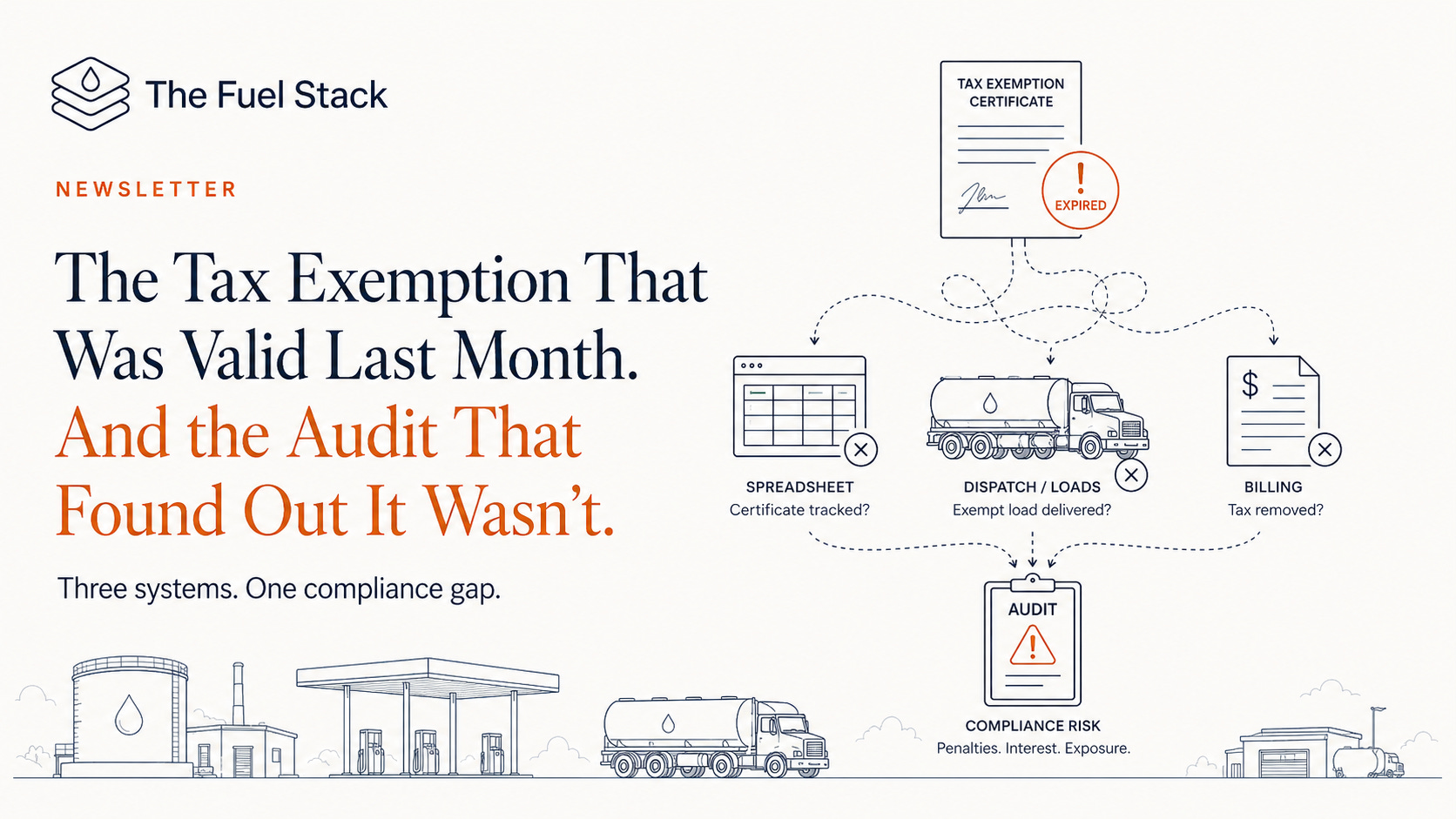
The spreadsheet had the expiration date. The dispatch system had the delivery dates. The billing software had the invoices. Three systems, all holding a piece of the answer, none of them talking to each other.
The three-system problem nobody designed
Billing applies tax treatment based on the customer record. If it says exempt, the invoice goes out exempt. It doesn’t check expiration dates. It wasn’t built to.
Dispatch assigns drivers, routes, and loads. It has no visibility into exemption status. Compliance isn’t dispatch’s job.
The spreadsheet is supposed to be the bridge. But it’s passive. It doesn’t know when a load gets dispatched. It doesn’t update when a delivery happens. It only knows what someone typed into it, and it only gets checked when someone remembers to look.
The certificate expired on a Tuesday. No alert fired anywhere. The driver picked up Wednesday’s load the same way he always had. By the time Maria found the problem, it was forty-two days and five deliveries old.
What Texas actually requires
Texas taxes diesel at twenty cents per gallon removed from a terminal, unless exempted by law.
An agricultural end user number allows up to 25,000 gallons of tax-free dyed diesel per month. A non-agricultural end user number caps at 10,000 gallons per month.
These limits reset every calendar month. They are not cumulative across the year.
Violations can exceed $10,000 per incident, plus back taxes. Federal penalties start at $1,000 per violation or $10 per gallon of improperly used fuel, whichever is greater, and apply to each separate incident.
Five loads against an expired exemption isn’t one incident. It’s five.
Two questions, asked at the wrong time
Is the certificate valid right now?
Not when the account was set up. Today. AG and DD numbers expire and get revoked regularly. Most billing teams check at onboarding, maybe annually. Almost nobody checks before every delivery, and dispatch certainly doesn’t, because dispatch doesn’t have the spreadsheet.
Has the customer hit their monthly limit?
This requires pulling delivery history, summing exempt gallons, and comparing against the spreadsheet’s stated limit. At fifty or a hundred deliveries a day, that manual cross-check doesn’t happen consistently. It can’t. There aren’t enough hours.
What an audit actually looks for
Fuel unaccounted for is presumed to have been sold or used for taxable purposes. The burden is on the distributor to prove an exemption was valid, not on the auditor to disprove it.
An auditor wants the valid certificate at the time of each delivery, proof it hadn’t expired, a month-by-month gallon count against the limit, and an invoice that reflects it correctly. If any of that is missing, you’re looking at back taxes, penalties, and interest, not just an awkward conversation.
The auditor does not care that the data was scattered across three systems. That’s your problem to solve, not theirs to accommodate.
What it would have cost
Five loads, roughly 4,000 gallons each, 20,000 gallons total.
State tax exposure alone: $4,000.
Federal exposure at the per-gallon rate: up to $200,000, in a worst-case reading.
In practice, enforcement varies, and a proactive first-time fix is treated differently than a pattern of evasion. But the asymmetry is the point:
The cost of the failure dwarfs the cost of the system that would have prevented it.
What actually closes the gap
Not a better spreadsheet. Not a fourth system. The exemption data has to live inside the same record dispatch and billing both use.
When a load is assigned to an exempt customer, the system checks the certificate automatically. Expired or expiring within thirty days, the load doesn’t move without a documented override. Every closed delivery updates the customer’s monthly exempt gallon total automatically. Approaching the limit triggers a flag both billing and dispatch can see.
The compliance logic has to live inside the workflow, not next to it.
The question worth asking this week
Pick your ten largest dyed diesel customers in Texas. For each: when does their certificate expire, how many exempt gallons have they taken this month, and how close are they to the limit?
Now ask where each answer comes from. Spreadsheet? Billing? Dispatch?
If you need three places to answer three questions about one customer, the compliance information isn’t in your workflow. It’s in the gap between your systems.
Maria got lucky. The customer called before the auditor did.
For the current Texas exemption rules, gallon limits, and registration forms referenced in this issue, see the Texas Comptroller's diesel fuel page: comptroller.texas.gov/taxes/fuels/diesel.php
About the author
I’m Dibyesh G., founder of Fueleo. I spend my time working with fuel marketers on the messy handoffs between pricing, dispatch, delivery, BOLs, invoicing, inventory, and accounting. This newsletter is where I write about the operational problems hiding inside everyday fuel workflows.
We don’t sell fuel in TX (only PA, DE, NJ & MD) but I could 100% see how this could happen with the software that exists in the fuel market.