

I’ve spent the last year sitting beside dispatchers, billing clerks, controllers, and fuel company owners. I ask them one question over and over:
“When did you last lose a customer and actually know why?”
It is the thing I do most in this industry. Not building. Not selling. Asking.
The answers are almost always the same. A contract ended. A competitor undercut the price. The customer moved operations out of the area.
What almost nobody says is: we lost them because billing kept making small errors and the customer got tired of checking.
Not because it does not happen. Because they usually do not find out until it is too late.
One story keeps coming back to me
An ops director in Texas told me about a construction company that had been a customer for six years. Consistent volume. Paid within terms. Never caused problems. The kind of account you stop worrying about because it has always taken care of itself.
The customer never called to complain. Not about the first billing error. Not about the second. Not about the third.
He just stopped answering when the sales rep called. Payments that used to come in at net 28 started arriving at net 38, then net 45. Volume dropped thirty percent over four months. Nobody flagged it.
When he finally said he was moving to a different supplier, the ops director asked why.
“The invoices were always a little off,” he said. “Not by a lot. But every month there was something. I just got tired of having to check.”
Six years. Three billing errors. Not a single escalation.
25 out of 26
Lee Resource found that 25 out of 26 dissatisfied customers never complain.
They simply leave.
That number hits differently in the context of fuel distribution.
In fuel distribution, customers often cannot verify what they received. They were not at the site. They do not own the metering equipment. They are trusting your numbers.
Every small billing mistake becomes another entry in a mental ledger.
The wrong rack differential applied to a load. The freight surcharge pulled from last month’s rate table. Dyed diesel billed with the wrong tax treatment. Each one small enough to pay without calling. Each one just large enough to remember.
They do not call to tell you the ledger tipped. They just stop calling to order
What I keep hearing about how errors go unconnected
When I ask billing teams about disputes they almost always describe individual incidents. A credit was issued. The ticket was closed. Everyone moved on.
What I rarely hear is someone describing those incidents as a pattern connected to a specific customer’s experience over time.
The wrong rack differential applied to one load. Caught and credited. Nobody asked whether the same pricing logic had run on other accounts that month.
A late invoice because dispatch closed the load a day behind. The customer’s payment came in late. Billing noted the slow payment. Nobody connected it to the late invoice.
A volume discrepancy. The invoice said 4,200 gallons. The customer’s equipment logs said 4,050. The customer paid and made a note to watch. They did not call.
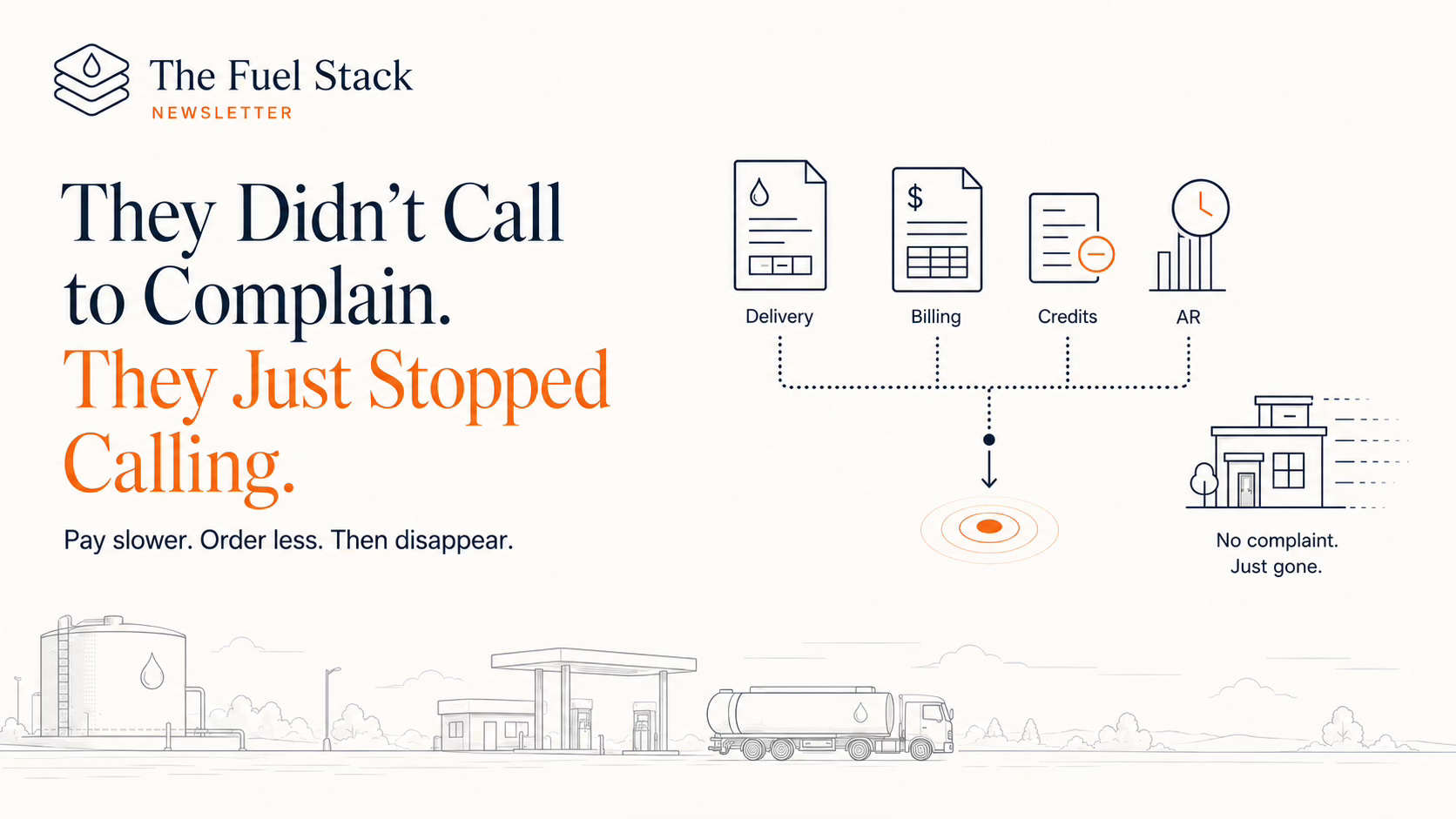
Three events. Three systems flagged them. Nobody’s job was to connect them.
That is how a six-year customer becomes a loss without a single escalation.
The AR report is telling you something nobody is reading
When I ask ops directors and controllers to walk me through accounts that started paying slower before they left, the pattern is almost always visible in hindsight.
First, payment timing drifts.
Then, volume softens.
Finally, the customer disappears.
Nobody connected those two things to the billing friction that had been happening on the account for months.
When a historically reliable fuel customer starts paying slower, it is worth asking a different question before it goes to collections. Sometimes it is cash flow. Sometimes it is their AP process.
But often it is a relationship signal hiding inside the AR report.
A customer moving from net 28 to net 45 may not look like churn. But in fuel operations, payment drift is often one of the first visible signs that trust is weakening.
What one AR manager told me
I was sitting with an AR manager at a mid-market distributor last year. I asked her how she knew when an account was starting to go sideways.
She thought about it for a moment.
“Honestly? When they stop calling about errors.”
I asked her to explain.
“When a customer disputes an invoice, it means they are still engaged. They care enough to call. When a customer stops disputing and just starts paying slow, that is when I get nervous. It usually means they have already decided something.”
That observation stayed with me.
The customer who calls to dispute an invoice is giving you a chance to fix the relationship. The customer who stops calling has already made a decision you do not know about yet.
The retention problem starts upstream of AR
When I talk to owners and ops directors about customer retention, the conversation almost always focuses on sales. Who is calling the account. When did the last check-in happen.
What rarely comes up is the operational chain the customer experiences every single time they receive a delivery.
Dispatch accuracy. Delivery confirmation. BOL capture. Pricing logic. Tax handling. Invoice timing. AR follow-up.
The customer experiences all of that as one thing: can I trust this supplier to get it right without making me chase them?
The fix is not another sales call. It is a connected workflow where delivered gallons, BOLs, contract pricing, taxes, fees, credits, and invoices are checked before the customer ever sees the bill. When those pieces connect, exceptions surface before the invoice goes out. The credit gets issued before the customer notices the discrepancy. The mental ledger never starts.
The more time I spend inside fuel companies, the more convinced I become that customer retention is not primarily a sales problem. It is an operational visibility problem.
The question worth asking this week
Look at your top twenty accounts by volume. For each one:
Is their payment timing faster or slower than six months ago?
Has their volume changed in the last ninety days?
How many billing credits have they received in the last year and were those reviewed as a pattern or resolved as individual tickets?
If you cannot answer those three questions without pulling data from multiple systems, you do not have a customer retention problem yet. You have a visibility problem. And the retention problem is building quietly underneath it.
The warning signs were never hidden.
They were sitting in dispatch.
In billing.
In AR.
In delivery tickets.
In credit memos.
Every department saw one piece.
Nobody saw the story.
About the author
I’m Dibyesh Giri, founder of Fueleo. I spend my time talking to fuel marketers about the messy handoffs between pricing, dispatch, delivery, BOLs, invoicing, inventory, and accounting. This newsletter is where I write about what I find.