

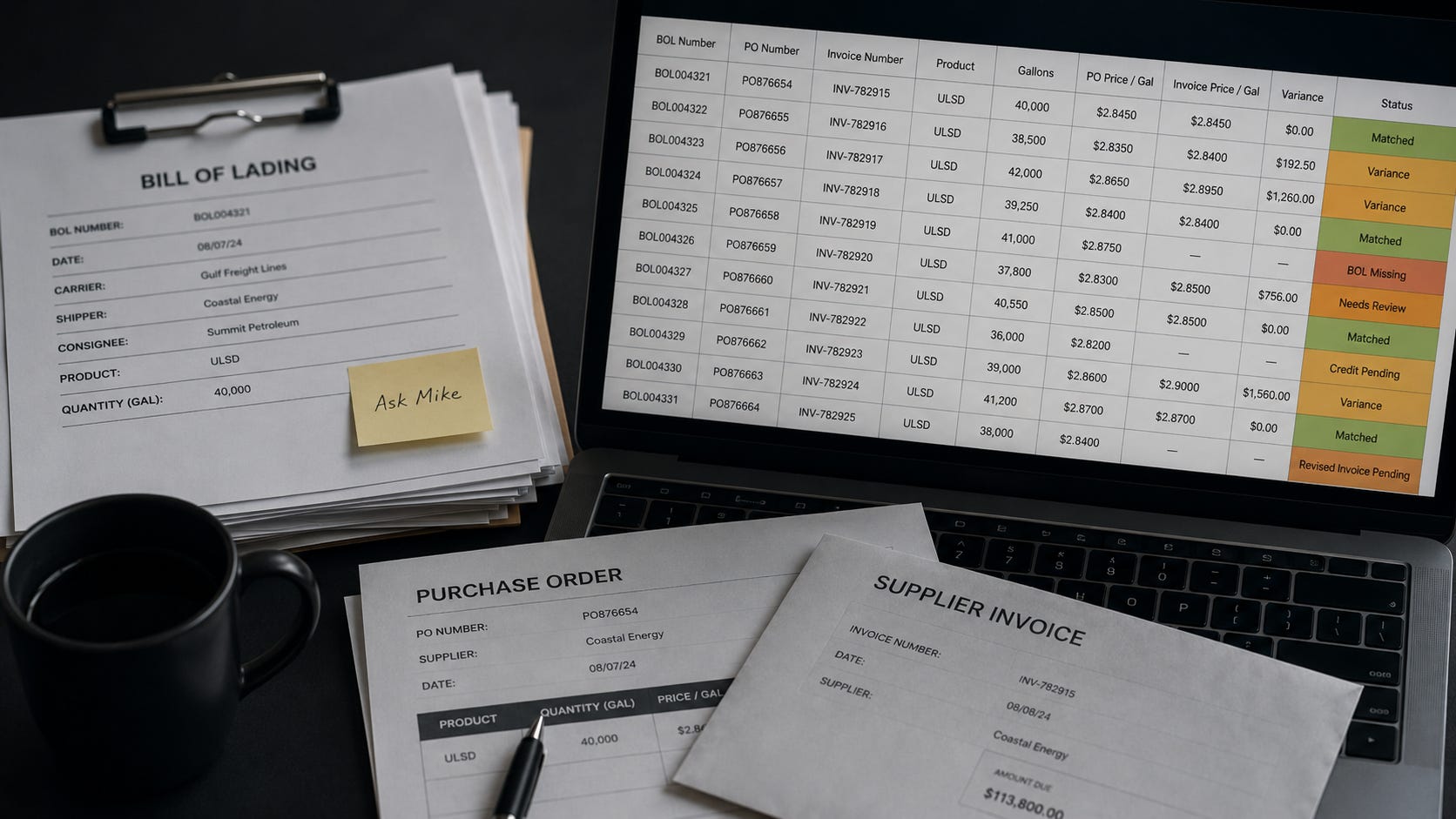
I talked to an AP manager at a mid-size petroleum distributor last year. She handles supplier invoices for a company doing around $80M in annual fuel purchase.
I asked her how she matches vendor invoices to BOLs and purchase orders.
She pulled up her screen and showed me a spreadsheet. Seventeen columns. Color-coded by status. A notes column with entries like “credit pending,” “called terminal, waiting on revised invoice,” and “ask Mike.”
She built it herself three years ago. Nobody else on the team fully understands how it works. She has not taken a full week off since.
That spreadsheet was not a tracker. It was the 3-way match process at an $80M fuel distributor.
What the textbook says versus what actually happens
Three-way match is straightforward in theory. Before paying a supplier invoice, AP confirms that the purchase order, the BOL, and the supplier invoice all agree. The supplier, terminal, product, BOL number, lift date, gallons, price, taxes, freight, and payment terms should all line up.
In fuel distribution, those three records almost never arrive together, in the same system, at the same time.
The PO, if it exists before the load moves, may live in QuickBooks, the ERP, or a purchasing worksheet. Many mid-market fuel purchases still start as a phone call, text, or email to a supplier. The PO is often created after the fact because the operational priority was getting product loaded before the customer called again, the weather changed, or the tank ran low.
The BOL may come back with the driver, get faxed from the terminal, arrive as a PDF, come through a terminal or DTN portal, or get uploaded from a mobile device. It often ends up in an email folder, shared drive, paper packet, or scanned batch that everyone can access and nobody truly owns.
The supplier invoice arrives by email, portal, mail, EDI, or PDF attachment two to five days after the lift. By then, AP has to reconstruct the transaction.
That someone is usually one person. And she built the spreadsheet because nothing else connected those three things.
Without integration across systems, matching becomes a manual scavenger hunt. In fuel distribution, that scavenger hunt happens dozens of times a week, across multiple suppliers, multiple terminals, and multiple product types, all with different payment terms moving toward due dates simultaneously.
Why fuel makes this harder than most industries
This is not a people problem. Fuel AP is structurally harder than generic AP because the transaction is not just vendor, item, quantity, and price. It includes terminal, lift date and time, product code, gross gallons, net gallons, rack basis, freight, fees, taxes, credits, and payment terms.
Rack price moves daily, sometimes intraday. The price on a supplier invoice may reflect the rack posting at the time of lift. That may not match what the buyer expected from a morning call, a contract basis, or an internal pricing sheet. A $0.015 per gallon discrepancy on a 40,000 gallon load is $600. It is easy to miss on a manual review when you are looking at a number that is close but not identical and you are not sure which one is right.
Volumes are measured in gross gallons and net gallons. The BOL may show both. The supplier invoice may show one. The difference is not automatically an error; it may be the result of temperature correction. But if AP does not know which basis the supplier used, a valid invoice can look wrong, or a wrong invoice can look valid.
Payment terms create real pressure. A distributor buying tens of millions of dollars of fuel annually may be managing millions in supplier payables at any given time. If matching takes too long, the company risks late fees, strained supplier relationships, missed early-pay discounts, or avoidable cash planning issues.
The spreadsheet is not a sign that the AP team is behind. It is a sign that nobody built a system that matches how fuel purchasing actually works.
What the data says about manual AP processes
The AP leakage problem in fuel distribution is not unique to the industry. But the commodity nature of the business amplifies every failure point.
Manual processing for an invoice can cost $12 to $30 per item. A mid-market fuel distributor processing 3,000 supplier invoices a year could spend $36,000 to $90,000 annually on manual invoice handling before accounting for payment errors, missed credits, duplicate invoices, and delayed approvals
The larger issue is not that AP people miss obvious errors. It is that manual review is inconsistent. When an invoice is close to expected, when the BOL is hard to find, or when the credit is buried in a note column, the process depends too much on individual judgment and memory.
According to data from the American Productivity and Quality Center, an average of 0.8% to 2% of companies’ annual disbursements are duplicate or erroneous. A SAP Concur study reported that 1.29% of invoices businesses process are duplicates, each valued at an average of $2,034.
Put that in fuel distribution terms. Even a small error rate on $50M of annual supplier payments can become a six-figure exposure. Not every error is recoverable. Some credits age out. Some duplicates are found late. Some pricing variances are never identified because they were close enough to pass manual review.
More than 25% of AP teams’ time is spent identifying and correcting payment errors, time that could otherwise be used for strategic work. At a lean mid-market distributor where the AP function might be one or two people, that is a significant portion of someone’s entire working week spent on error correction rather than financial oversight.
Where the money quietly leaves
The financial exposure from manual 3-way match in fuel distribution usually falls into a few repeatable categories.
Pricing variances that slip through. A supplier invoices at a rack basis, contract basis, or terminal posting that does not match what the buyer expected. The difference is $0.02 per gallon on a 35,000-gallon load. That is $700. On a manual review, with fifteen other invoices waiting and payment terms approaching, it gets marked close enough and paid.
Credits get promised but never closed. A short delivery, pricing correction, freight issue, or tax adjustment gets discussed by phone or email. The supplier agrees to apply a credit on the next invoice. AP writes “credit pending” in the spreadsheet. The next invoice arrives. The credit is missing. Someone means to follow up. Month-end hits. The issue gets buried.
Duplicate payments. The same invoice enters through multiple paths. It arrives by email, then again through a vendor portal, then again in a scanned packet. If invoice number, supplier, amount, BOL, and lift date are not matched systematically, both versions can move forward.
None of these are dramatic in isolation. Together, at volume, across a full year of fuel purchasing, they are a real number sitting inside your AP line that nobody is measuring.
The spreadsheet holding it together
Every mid-market fuel distributor has some version of this spreadsheet.
Columns for supplier, terminal, invoice number, BOL number, lift date, product, gross gallons, net gallons, invoice gallons, expected price, invoice price, variance, credit status, payment terms, and notes column with entries like “within tolerance,” “credit pending,” or “ask Mike.”
It was built by someone who understood the exceptions. It works because that person knows what the colors mean, which variances matter, which supplier needs a phone call, and when “ask Mike” is the fastest path to the truth.
The person who maintains it goes on leave. A formula breaks. The transaction volume grows and a new tab gets started for the current month without fully closing out the previous one.
At that point, your most important AP control is running on something one person understands and nobody has documented.
The spreadsheet does not just track invoices. It stores the company’s unwritten rules: which terminal is always off by a few gallons, which supplier tends to miss credits, which product code maps incorrectly, and which variance is safe to clear.
That is exactly what the spreadsheet represents. Not a system. Tribal knowledge in column format.
What clean AP actually requires
The fix is not a better spreadsheet. It is a transaction record that starts before or at the time product moves and follows the load through BOL, invoice, approval, credit, and payment.
It means capturing the BOL as close to the lift or delivery event as possible, not days later when paperwork is scanned. It means connecting the PO or purchase intent to the load, even if the formal PO is created later. It means receiving the supplier invoice in a structure that can be matched against the BOL and purchase record without AP re-keying every field.
When those three documents are linked to the same transaction before AP touches it, matching becomes exception review instead of a document hunter.. The system flags the 150-gallon variance. AP determines it is within terminal tolerance and clears it in two minutes.Everything that matches cleanly moves to the payment queue with the right controls, approval rules, and payment timing.
The AP person who spent days at month-end reconstructing transactions from scattered documents now spends time on the discrepancies that actually require judgment.
That is not a software pitch. It is what happens when the document workflow is designed before the matching step, instead of the spreadsheet being built to compensate for the fact that it wasn’t.
The question worth asking this week
Find the last vendor invoice your AP team flagged as a discrepancy. Trace it back.
Then ask:
Where was the BOL when the invoice arrived?
Was the PO or purchase record already tied to the load?
Was the invoice matched against gross gallons or net gallons?
Was the rack price checked against the right terminal and lift date?
Was there an open credit tied to that supplier, BOL, or invoice?
How long did it take AP to resolve the exception?
Then ask how many invoices went through last month without that level of scrutiny. And whether the ones that didn’t get flagged were actually correct, or just close enough.
The spreadsheet is holding it together. Until the person holding the spreadsheet is unavailable.
Next issue: The ERP that was supposed to fix everything and didn’t.
About the author
I’m Dibyesh Giri, founder of Fueleo. I spend my time working with fuel marketers on the messy handoffs between pricing, dispatch, delivery, BOLs, invoicing, and accounting. This newsletter is where I write about the operational problems hiding inside everyday fuel workflows.
Great insight, I agree and have seen this in every market of the US across nearly all mid size jobbers. I honestly feel that if these jobbers understood the operational cash flow ability fixing these manual process create, working capital available because their customers are billed the same day. It’s refreshing hearing the pain points I experienced and the solution available, well done Dibyesh!