

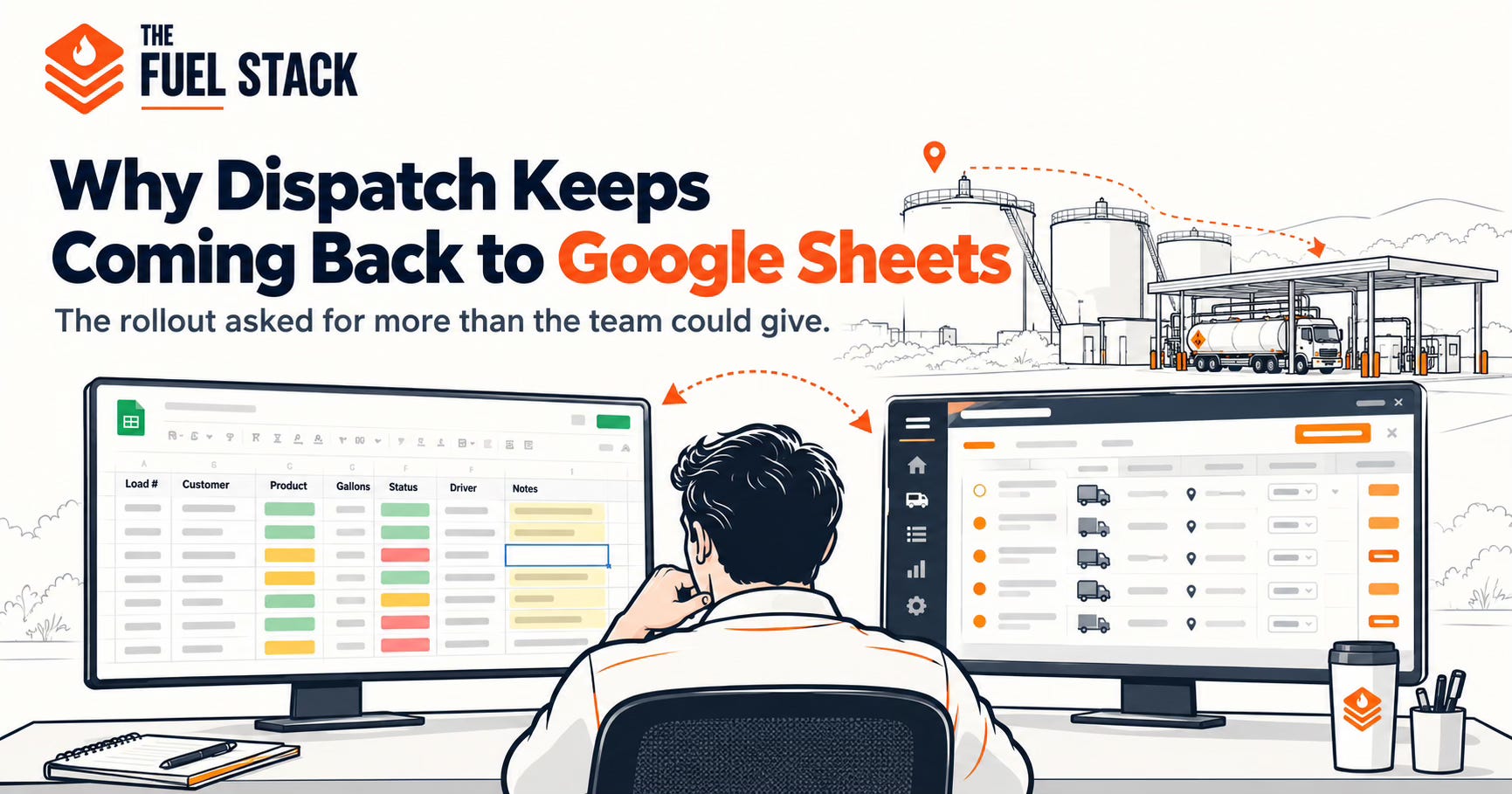
At WPMA last year, I heard a fuel marketer describe a software rollout that ran seven or eight months.
They kept their Google Sheets dispatch board running the whole time, right next to the new system. Nobody wanted to risk a missed delivery while they figured it out. So every order, every assignment and every change got entered twice. Then someone checked whether the two matched.
They spent thousands of dollars. Their team spent more hours than anyone counted.
Eventually, they stopped. The new system went on the shelf, and dispatch went back to the Google Sheet that had worked for years.
It’s easy to call that resistance to change. I don’t think it was.
The team didn’t reject software. They rejected a rollout that cost more every day than the problem it was supposed to fix.
The idea of modern dispatch didn’t fail. The rollout did.
The sheet is doing real work
A dispatch board isn’t just a list of orders. It’s a live picture of today.
It shows which loads have to move and which truck can carry them. What’s still in each compartment. Which customer is close to running out. Which order just turned urgent. What changed five minutes ago.
Google Sheets holds a lot of that on one screen. Everyone can edit at the same time. They can leave comments, filter their own view, and pull up an earlier version if something gets overwritten.
And when something new comes up, the dispatcher just handles it. They add a column, color a row red, type a note, or make up a status nobody’s used before. No support ticket. No waiting on a vendor.
That’s not messy data. It’s years of operating knowledge, built by the people doing the work.
The sheet wins the morning because it bends. It lets the operation write down what’s really happening before anyone has standardized it.
Where rollouts go wrong
When dispatch software fails, people usually blame the software. Most of the time, that’s not the main problem.
Read the research on failed ERP projects and the same reasons keep coming up. Too little training. Poor fit with how the business actually runs. Weak project management. Users who were never really brought in.
In fuel, the gap usually shows up first at dispatch.
The demo shows clean orders. Your Tuesday looks like this: retained product, a terminal change, a partial drop, a wet-hose job, a customer on credit hold, a meter correction, an emergency call, and a driver who called in sick.
If those cases only show up after go-live, the new system becomes one more thing the dispatcher has to work around.
The parallel run trap
Running both systems side by side sounds safe. If the new one breaks, you still have the old board. You can compare the results before you commit.
That works when the parallel run is short, small, and has an end date.
Without those, the safety net becomes the problem.
Every transaction gets entered twice. Someone has to reconcile the two. Reports disagree. Every day, someone decides which board is the real one. And when an urgent change only makes it into one system, the two drift apart.
To see the cost, compare two numbers every week:
What the parallel run costs: double entry, reconciling the two systems, implementation meetings, chasing issues, vendor fees, and the regular work that slipped.
What the spreadsheet costs: manual entry, calls and texts to drivers, chasing missing details, matching BOLs to deliveries, late invoices, and fixing mistakes.
The first cost is loud. Everyone feels it every day.
The second is quiet. It’s spread across dispatch, billing and accounting, and it’s been there so long it feels normal.
That’s why going back to the sheet feels like a win. The loud cost disappears overnight. The quiet one comes right back.
Seven or eight months isn’t a test anymore. It’s a second way of running the business.
A parallel run should answer specific questions. Do the gallons match? Do assignments reach the driver? Can a delivery become an invoice? Can we turn off the old board?
If nobody can say what’s still being tested and when it ends, the parallel run has become a tax on the team.
Tired people can’t test anything
Rollout plans count licenses, integrations, consultants and training sessions. They rarely count people’s attention.
The few people who know the old process best are asked to keep the trucks moving and explain everything to consultants. They also clean up data, test settings, train coworkers, report bugs, and enter everything twice.
They’re the people you need most for the rollout. They’re also the people who can least afford to step away from the day.
Once they’re tired, the test stops meaning much. Steps get skipped. One system gets updated and the other doesn’t. Reconciliation turns into a quick look. Training gets bumped because a customer is on the phone.
Then mistakes caused by the double work get blamed on the new software.
By the time the owner asks “Is the new system working?”, the team is really answering a different question: “Can we survive another month of this?”
Going back to the sheet is triage. It means the company ran out of room for change.

Running dispatch on a spreadsheet?
Nothing to be embarrassed about. Some of the sharpest dispatch boards I’ve seen live in Google Sheets. If you’ve tried to move off yours, or you’re thinking about it, I’d like to hear how it went.
Dibyesh G.
A better way to switch
The answer isn’t banning spreadsheets or asking the team to push harder. It’s changing less at once.
Start with the sheet. Before you change anything, write down what every column, color and note on the current board means. Treat the sheet like a prototype your team built over years. The new board should feel familiar on day one.
Pick one loop. Don’t rebuild everything. Pick one path that matters: order → dispatch → delivery → gallons delivered → ready to invoice. Run it first with one terminal, one truck group or one dispatcher.
Compare in the background before anyone types twice. Where you can, feed the new system from the old one automatically and compare the results in the background. Only ask people to enter things twice when you need to prove something specific.
Write the exit rules first. Before the parallel run starts, decide:
What’s in scope
Which system is the official record
What has to match exactly, and what difference is OK
How many clean days you need
Who decides to go live, pause or roll back
The date it ends
Without those, every new bug resets the clock.
Make room for the work. If your lead dispatcher needs 15 hours a week to test, take 15 hours off their plate. Bring in help or shrink the pilot. Don’t pay for the rollout with their nights and weekends.
Train on real days. Use your actual exceptions, not clean demo orders.
Plan the way back. Keep a read-only copy of the old board. If the pilot fails, roll back on purpose and write down why. Going back should be a decision. It shouldn’t be the day a worn-out team quietly stops opening the new system.
That’s how we try to roll out Fueleo too. Start small, go one loop at a time, and don’t make anyone live in two systems for months.
What the spreadsheet is telling you
When dispatch goes back to Google Sheets, the sheet isn’t proving software can’t work. It’s showing you what the rollout missed.
Maybe the new way was slower. Maybe the exceptions were never built in. Maybe it stopped at dispatch and never reached billing. Maybe the team learned screens instead of real work. Maybe the parallel run never ended.
Or maybe the company just didn’t have room to change everything at once.
Google Sheets is a good dispatch board. It’s flexible, and it matches how dispatchers think. But it isn’t free. The retyping, disconnected delivery records, late reconciliation and late invoices keep adding up after the board is done.
So the lesson isn’t “stay on spreadsheets.” It isn’t “buy a bigger system” either.
Change things in the order your team can handle. Keep what works. Fix one loop. Prove it small. Expand only when the team feels less work, not more.
The best dispatch system isn’t the one with the most features. It’s the one that earns the right to replace the spreadsheet.
The parallel-run trap is a good call-out: without an end date, double entry quietly becomes the process. A practical fix is to set a cutover date up front and move one small slice first, like a single route or product, so the team finds the Tuesday-type edge cases early. Did any of the fuel marketers you've talked to try a phased rollout like that?