

Say you run 15 trucks and handle replenishment for 300 customer tanks. How much of that operation depends on what your dispatcher knows?
Readings come in from monitoring portals, email alerts, texts, photos of ATG printouts and phone calls. Your dispatcher pulls them together, decides who needs fuel, and builds the day around it. On a busy day, that can take a good part of the morning.
It works, but the costs rarely show up as a line item. You pay for those hours every day. Much of the know-how lives in one person’s head. A missed tank can turn into an emergency delivery that erases the margin on that load, or into a customer who starts shopping around. And every new account adds to the pile.
So when a vendor says, “Connect your ATGs, set a threshold, and our AI will create the orders,” it’s easy to see the appeal.
The better question to bring into that meeting is this:
Does the system handle the full delivery decision, or just the tank reading?
Same reading, very different risk
Two customers each have a 2,000-gallon tank holding 500 gallons. At 25%, a simple threshold creates an order for both.
Customer A uses about 100 gallons a day. Customer B uses about 400.
Before allowing for any minimum reserve, Customer A has about five days of fuel. Customer B has about 30 hours. If your next open truck is two days out, Customer B is your next runout.
And that math assumes steady usage. A contractor ramps up for a big project. A farm heads into harvest. A fleet picks up a new route. Any of these can shrink the delivery window. A useful forecast picks up those patterns and tells you how confident it is. A daily average with a new label doesn’t.Knowing the customer means more than the burn rate
Knowing the customer means more than the burn rate
Knowing the customer goes well beyond knowing how fast they use fuel.
Picture a tank that needs fuel tomorrow. The site only takes deliveries before 10 AM, the customer wants to approve every order, and the gate can’t fit your largest truck. Your dispatcher knows all of that without looking it up.
Does the recommendation account for it? Or does it create an order your dispatcher has to rework by hand?
Delivery windows, site access, approval rules, usable tank capacity and operating schedules are what turn a reading into a delivery. If the system doesn’t know them, your dispatcher is still doing the real work.
Readings come from everywhere
Say a new system connects to three major monitoring providers, and 60% of your tanks use them. That can be a real help.
But ask how much daily work is left for the other 40%: the emails, texts, photos and calls. If your dispatcher now has a second queue to manage beside the new screen, some of the savings go into handling it.
Collecting a reading also isn’t the same as trusting it. A photo can be a day old. A text can refer to the wrong tank. A portal can show a stale timestamp. The system should tie every reading to a tank, a source and the time it was taken, and flag readings that don’t add up before they drive a delivery.
Different levels don’t automatically mean something is wrong. A tank at 800 gallons yesterday and 500 today may just be normal usage. What matters is whether the change makes sense given the time between readings, expected usage and known deliveries.
The same goes for a customer who fills up somewhere else. If a newer reading comes in, a good system can flag the unexpected jump before your truck rolls. If nothing new arrives, no software can know. That’s when you want it to say, “This reading is old. Someone should check the tank.”
An order isn’t a delivery yet
Suppose the forecast is right and the customer needs 800 gallons tomorrow. Dispatch still has practical questions to answer. Is a truck free, with the right product on board? Can the stop ride with two nearby deliveries? Is the driver close to their hours limit? Will the tank take the full load when the truck arrives?
There are often two ways to cover it: a dedicated trip today, or a stop tomorrow on a route already headed that way. Both may prevent a runout, but their delivery costs can be very different. The system should help your dispatcher see that difference, not hide it.
How it should work
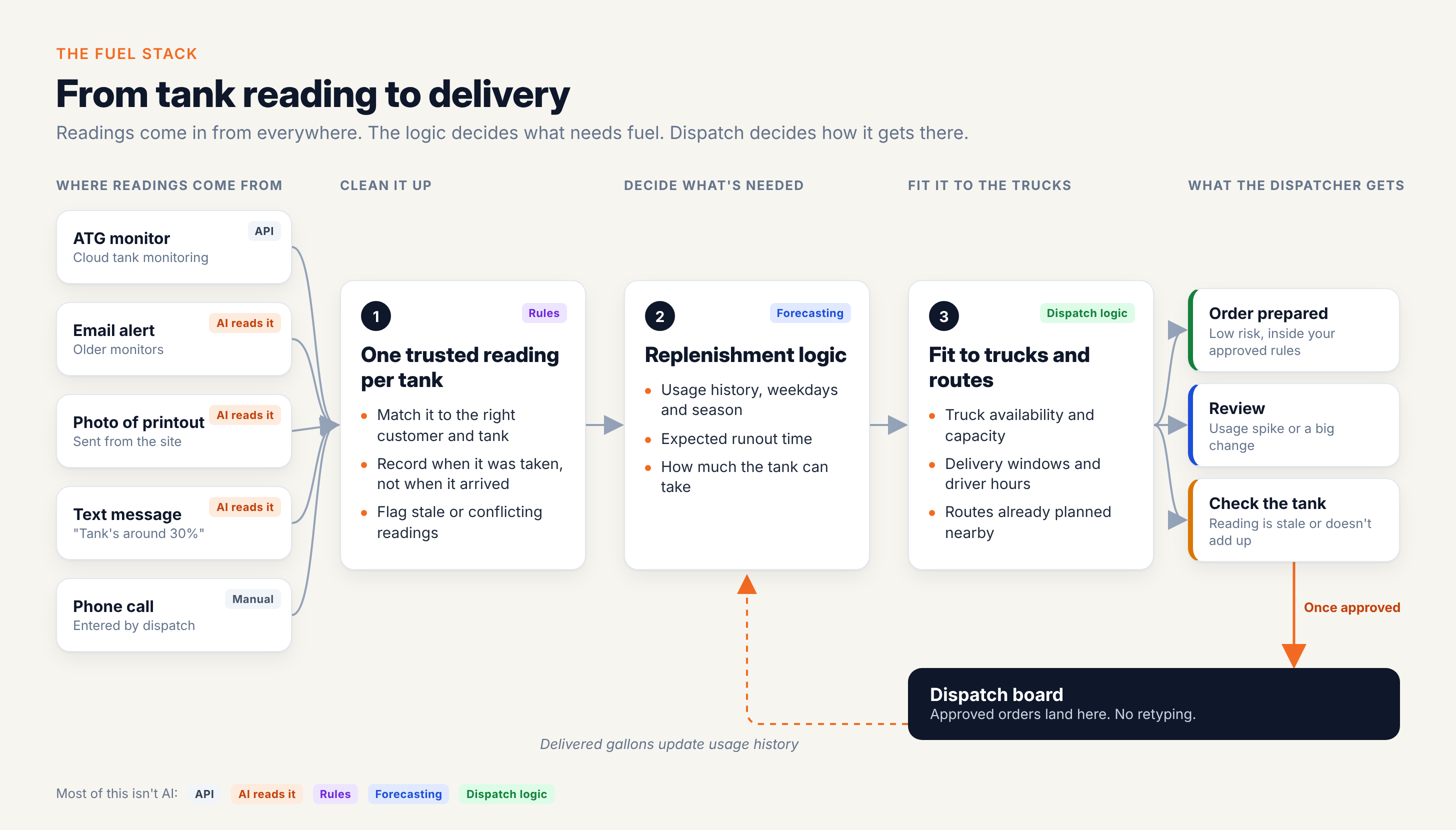
Every reading is tied to a customer and tank, with its source and timestamp. The system estimates when each tank will run out and how much it can take. Then it fits the delivery to your trucks, the customer’s delivery rules and the routes you’ve already planned.
At 7 AM, your dispatcher sees one list. It shows tanks likely to drop below reserve before a truck can get there, tanks that stopped reporting, customers whose usage changed, and deliveries that fit existing routes. Routine orders are prepared under rules you approve. Anything unusual is flagged with a reason. Approved orders go straight to dispatch, and each delivery feeds back into usage history.
For you as the owner, there’s another benefit. The knowledge that used to live only in your dispatcher’s head starts living in the system, where the next person can use it too.
Three tests for the demo
Ask the vendor to run these on your own scenarios, not their sample data.
1. Two readings on an unconnected tank. Send an old photo and a newer text with different levels. Does the system match both to the right tank, keep the time each was taken, and flag the change if it doesn’t fit expected usage or known deliveries?
2. A sudden change in usage. Triple a customer’s consumption over a few days. Does the recommendation change, and does the system show how much it trusts the new pattern?
3. A constrained delivery. The customer needs fuel, but the site is closed tomorrow and the nearest truck doesn’t have enough product. What does the system recommend?
In each case, your dispatcher should be able to see why the system made its recommendation, and override it with a recorded reason.
Also ask what runs automatically, what depends on rules you set, and what still needs a person. A clear answer tells you more than the word “AI” on the brochure.
Measure what matters
Before any pilot, take a baseline. Track dispatcher hours spent collecting readings, runouts and emergency deliveries, gallons per stop, and trips that could have been combined. Then compare against a similar stretch after the system goes live, so a slow month doesn’t flatter the results.
Faster order creation alone doesn’t prove anything. Fewer runouts, fewer wasted trips and less time chasing readings do.
The goal was never more orders. It’s the right fuel to the right customer at the right time, at a cost that makes sense.
Which tank readings does your dispatcher still have to chase by hand? Reply and tell me. And if you’re evaluating auto-ordering and want a second set of eyes on the demo, book a time and bring it along.