

Cate sent me an email on a Thursday morning.
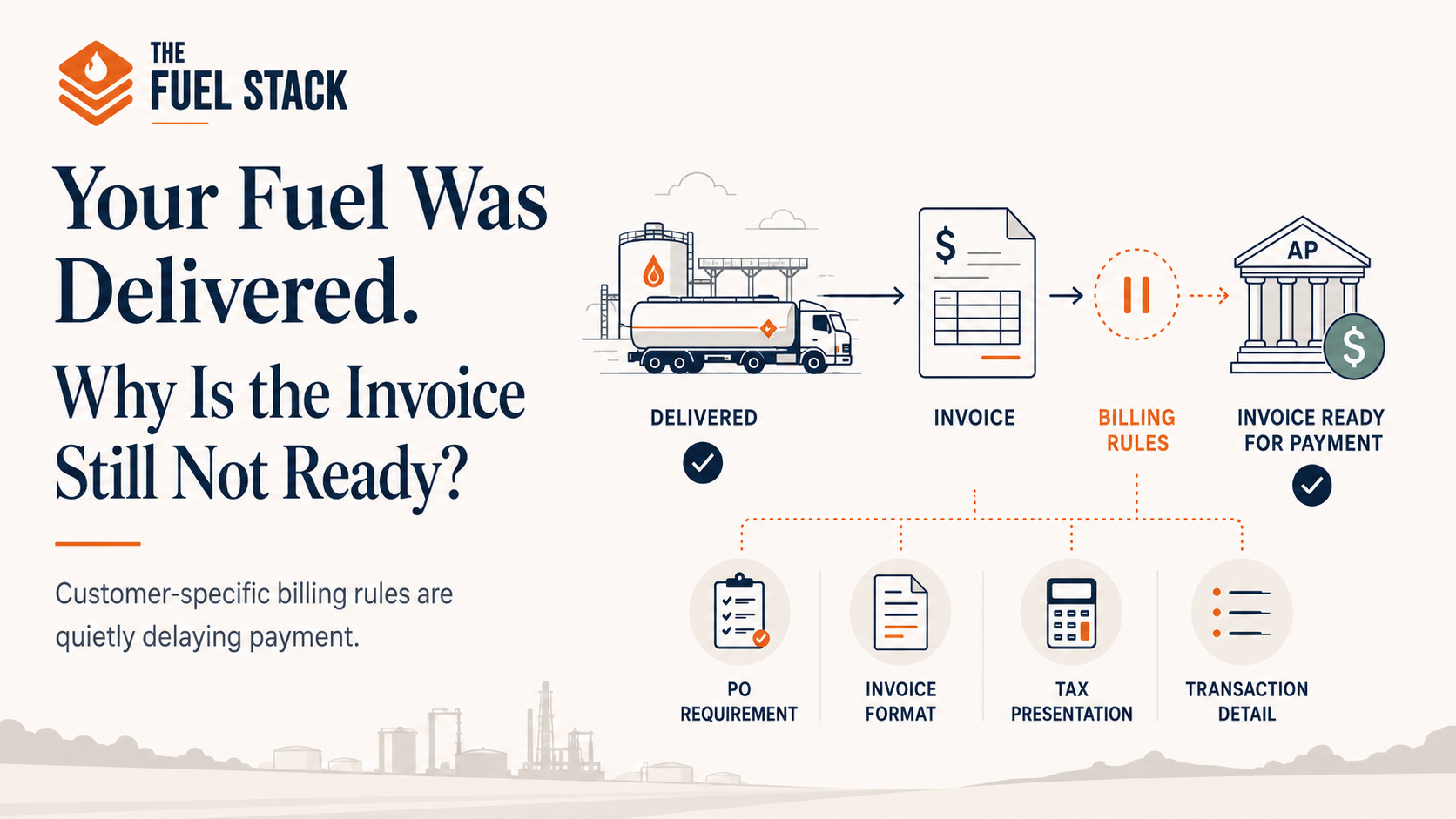
She runs billing for a Texas fueling company. One of her largest customers had a specific requirement for how they wanted invoices presented. Not a different price. Not a different product. A different format. The layout the customer’s AP team expected before they would process payment.
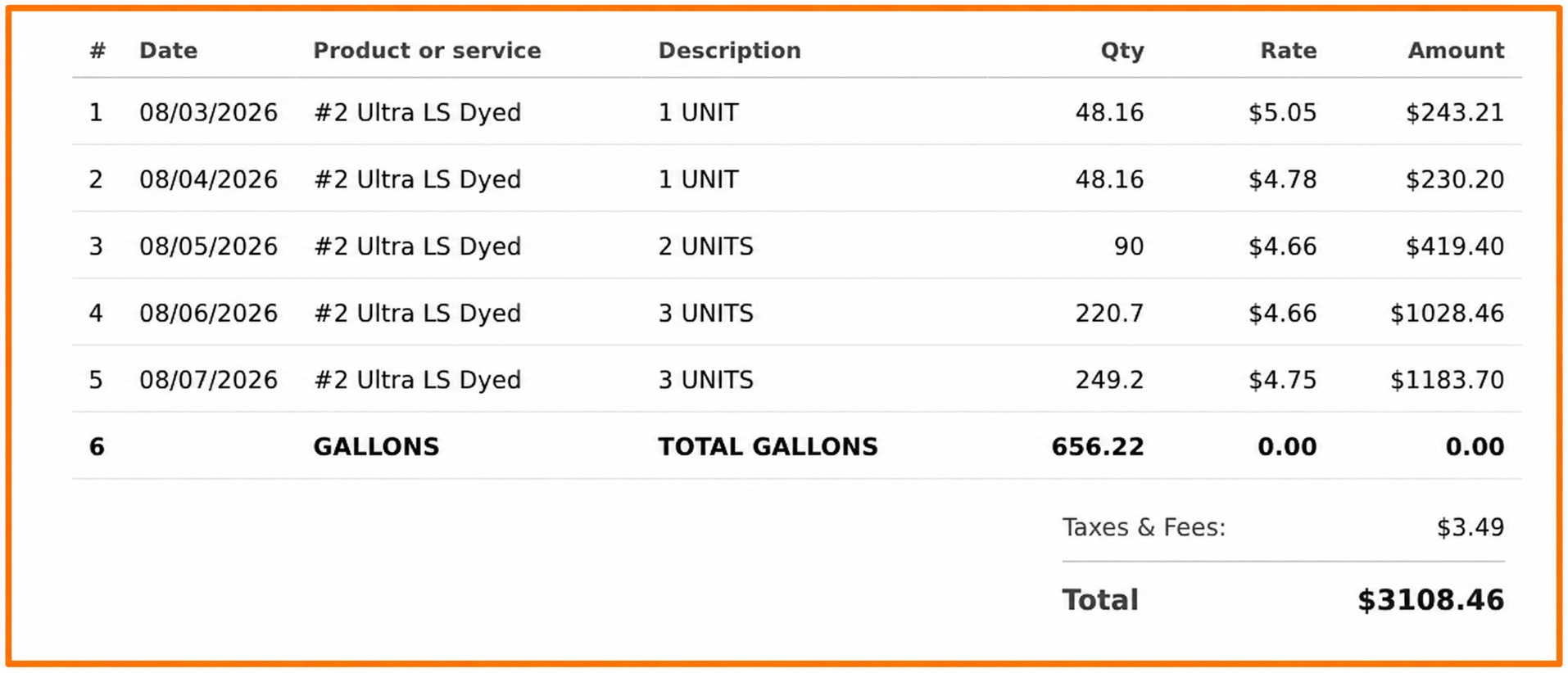
“Dibyesh, can we create a bulk invoice in this format?”
Simple request. Reasonable customer. The kind of thing you do when an account matters enough to go the extra mile.
The problem was that going the extra mile meant someone on Cate’s team manually rebuilding the invoice every billing cycle.
Cate’s request was not unusual. It was the fourth version of the same conversation I had heard in two months.
Four companies. Four different definitions of an acceptable invoice.
Garrett at American Petroleum started serving equipment rental companies. His customer’s AP team would send the PO number only after receiving the invoice. His billing team had to reopen the invoice, add the PO, generate a new copy, and resend it. Every single time. Three days lost before the invoice even entered the customer’s payment workflow.
Carina is the CFO of an East Coast fuel company. One of her largest customers wanted applicable tax calculated and displayed after every individual delivery line. Not summarized at the bottom the way every accounting system defaults to. Her billing team was manually reworking invoices for that account every billing cycle.
Andy runs a fuel wholesale operation in Washington state. His B2B customers pull their vehicles into his cardlock facilities, swipe a card, and fuel up. Every transaction is tracked: which card, which vehicle, how many gallons, what time. At the end of the billing period his customers want one invoice. Total gallons. Total charges. And underneath that, the full transaction-level breakdown. Every card swipe. Every vehicle. Every gallon traceable to a specific fueling event.
QuickBooks sees one invoice. Andy’s customer needs one invoice that contains hundreds of individual events.
At first these looked like four unrelated requests. They were not.
They were four versions of the same operational problem: the rules for getting paid lived in people’s heads instead of in the system.
The gap between delivery software and accounting software
Generic accounting systems were built around a simple model.
Customer plus items plus quantity plus price plus tax equals invoice.
That model works when every customer receives the same invoice format and the only variables are what was sold and at what price.
Fuel distribution does not work that way.
The invoice may depend on whether deliveries are billed individually or consolidated. Whether it is organized by customer, by location, by asset, by department, or by PO number. Whether the BOL and delivery ticket are attached. Whether the customer provided a PO before or after delivery. Whether tax appears summarized at the bottom or calculated and displayed after each delivery line. Whether cardlock transactions are consolidated by billing period or broken out by vehicle and card.
QuickBooks and most general-purpose ERPs can record the final invoice. Out of the box they usually do not know how to combine delivery records, BOLs, cardlock transactions, pricing rules, tax treatment, and account-specific billing instructions into a customer-ready invoice.
When the system cannot handle the complexity, the billing team absorbs it. Manually. Every billing cycle. For every account that falls outside the default.
What that actually costs
The manual work is visible. Someone rebuilds Cate’s bulk invoice. Someone adds Garrett’s PO number and resends. Someone recalculates Karena’s tax lines. Someone pulls Andy’s cardlock transaction history and assembles the consolidated breakdown.
The cost underneath is less visible.
In practice, many AP teams will not release an invoice into their payment workflow until all required information and supporting documents are present. If regeneration and resubmission takes three days, that is three days lost before the invoice even entered the customer’s payment workflow on a delivery that was completed on time.
Across multiple accounts with multiple billing requirements, that slip compounds. A fuel marketer running significant monthly receivables can have tens of thousands of dollars waiting outside the customer’s payment workflow not because customers are not paying but because invoices are not ready to be paid.
The delivery was on time. The fuel was correct. The invoice failed the last test before payment.
What a billing rules engine actually does
When Cate sent that email I realized the problem was not a one-off customization request.
It was a structural gap in how invoicing software thinks about fuel customers.
We stopped treating these as invoice customizations and started treating them as account-level billing rules.
In Fueleo, each customer profile defines its billing cadence, consolidation method, required PO fields, tax presentation, supporting documents, transaction detail, and approval requirements. When a delivery is completed, the system already knows what must happen before that invoice can be released.
Cate’s consolidated format generates automatically from the customer profile. No manual rebuilding.
For Garrett, Fueleo generates a preliminary billing document when the delivery is complete. When the customer returns the PO number, it is applied to the final invoice without rebuilding the document or re-entering the delivery data.
For Karena, tax is calculated and associated with each delivery line, then presented in the exact structure her customer’s AP team requires. It is not manually moved after invoice generation.
For Andy, cardlock activity is consolidated into one invoice with a traceable transaction appendix. Every card swipe visible. Nobody assembles it manually.
The accounting system still receives the financial transaction. Fueleo handles the operational work required to make that transaction billable.
The question worth asking
If you are a fuel marketer running accounts with specific billing requirements, one question is worth sitting with honestly.
Where do your customers’ billing rules live today: in your system, or in someone’s memory?
Because QuickBooks and most general-purpose ERPs do not carry those rules. They record the invoice after the fact. The customer-specific requirements that have to be met before the invoice is ready to go out live somewhere else. Usually in the billing team’s memory. Usually applied manually. Usually working fine until the person who knows it all is out sick, or leaves, or the account volume grows beyond what one person can handle.
Customer-specific billing should not require manual billing.
The fuel was delivered on time. The invoice should be ready the same day, even when every customer wants it differently.
Cate’s email was not simply a request for another template. It was evidence of a structural gap between delivery completion and invoice readiness.
The invoice is the last mile of fuel delivery.
Most fuel marketers are still walking it by hand.