

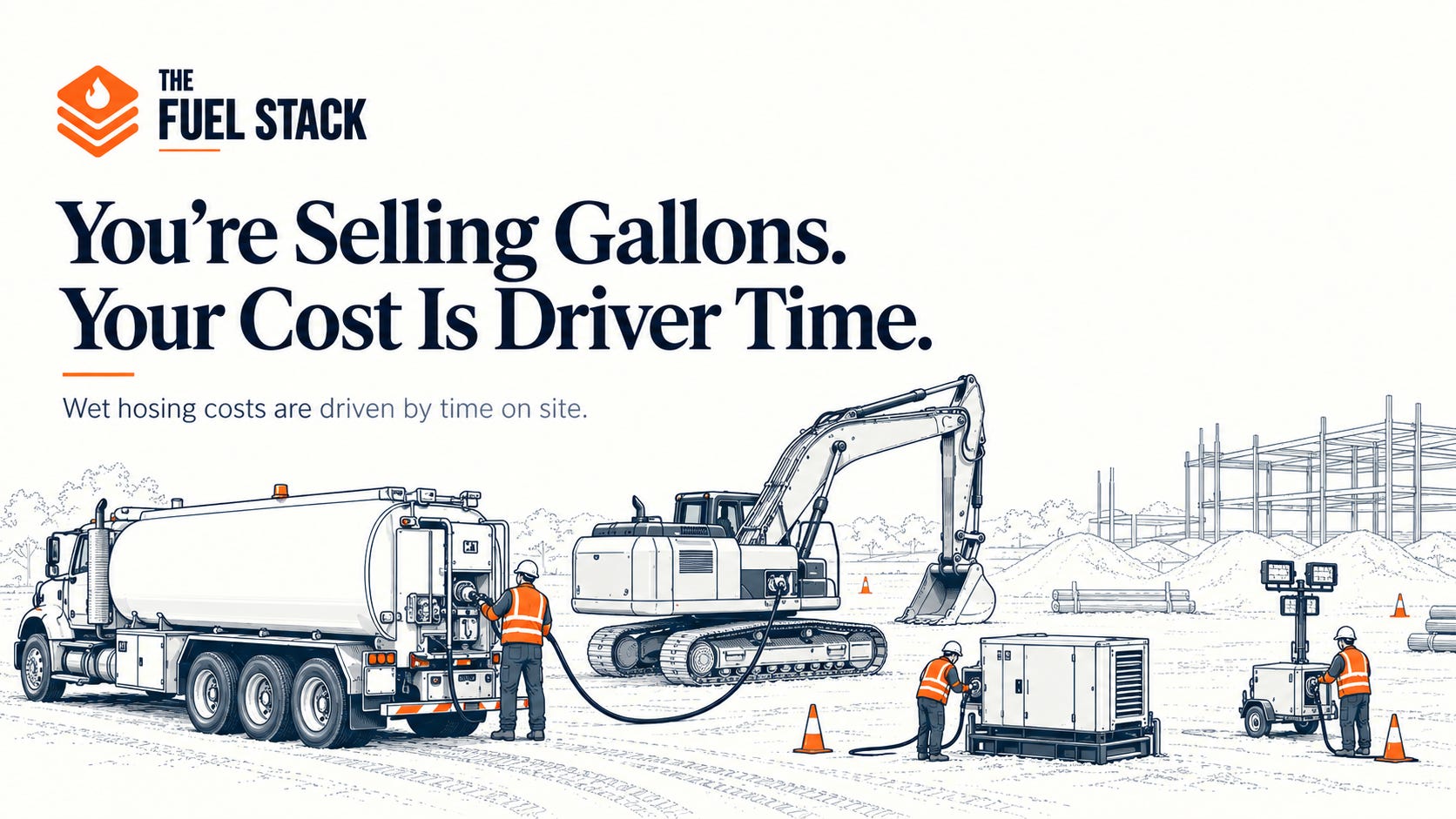
I keep thinking about one construction site delivery.
640 gallons. Eighteen pieces of equipment. The driver was on site for two hours and twelve minutes.
Then I looked at the invoice.
One line for diesel. 640 gallons. A delivered price that looked perfectly reasonable against the rack.
If you only looked at the invoice, the job looked fine.
But that invoice was missing the most expensive part of the delivery.
Two hours and twelve minutes of somebody’s day.
And that is where wet hosing gets interesting.
Wet hosing is not a bulk delivery problem
A bulk load is fairly easy to understand economically.
Load the truck. Drive to the customer. Drop several thousand gallons into a tank. Move on. Volume helps. If you are already sending the truck, delivering 4,000 gallons is almost always better than delivering 600.
Wet hosing behaves differently.
The driver arrives at a construction site and fuels individual assets one by one. Not tanks. Machines spread across an entire job site. Some labeled clearly. Some not. Some accessible immediately. Some requiring a supervisor to unlock them, a piece of equipment to be repositioned, or a conversation with a site manager who is in the middle of something else.
Unlike bulk delivery, wet hosing is often demanded at night when equipment is idle and trucks will not block day-to-day operations. A stop that takes two hours in daylight can take longer at night with limited visibility and reduced site access.
The driver is not simply delivering diesel. He is navigating a job site, finding equipment, coordinating with people, and fueling assets one at a time.
The gallons matter. But the clock matters too.
Sometimes more.
The driver behind the wheel is not cheap
Before we get to the margin math, one thing is worth naming directly.
A wet hosing driver is not a standard delivery driver.
CDL. Hazmat endorsement. Tanker certification. The licensing requirements narrow the labor pool and raise the cost of the hour before the truck ever leaves the yard.
Add the overtime premium for night fueling, higher turnover from demanding hours, and the cost of training replacements, and the driver hour is already expensive before the stop begins.
A per-gallon margin designed for bulk operations is not carrying those costs accurately.
The stop that should have looked different on paper
The driver arrived at 7:14am. He left at 9:26am.
Eighteen assets. Three generators. Two light towers. One machine that needed a supervisor to unlock it. Two pieces of equipment that had been moved since the order was created. Finding them took twenty minutes.
Total delivered: 640 gallons.
Put a normal rack-plus-margin calculation on those gallons and the delivery looked acceptable.
But think about what the truck and driver were doing for those two hours and twelve minutes.
They were not available for another customer. Wages were running. The truck was running. Insurance, maintenance, and overhead did not stop because the hose was moving from one asset to another.
A margin that works when you drop 4,000 gallons into one tank can disappear quickly when 640 gallons takes more than two hours to deliver.
And that is the daytime version of this problem. Run the same stop at midnight with limited lighting and a crew that is not there to help locate equipment. The time goes up. The cost goes up. The invoice stays the same.
This is where wet hosing pricing gets dangerous
Most wet hosing pricing still has its roots in traditional fuel distribution. Rack plus margin. Maybe a delivery fee. Customers understand it. Operators understand it.
The problem is that wet hosing introduces a cost that does not move neatly with gallons.
Time.
Consider two deliveries on the same day.
Stop A: 800 gallons. Six assets. Everything staged and accessible. Driver finished in 45 minutes.
Stop B: 800 gallons. Twenty-two assets. Equipment spread across the site. Three assets need to be located. Driver waits for a supervisor. Total time: two hours and twenty minutes.
Same gallons. Same invoice structure. Completely different economics.
Yet if both customers are priced on the same rack-plus-margin, those two invoices look nearly identical.
That is why wet hosing operators need to know one number that rarely shows up on a fuel invoice.
Margin per driver hour.
I would not stop charging by the gallon
Customers understand gallons. Nobody needs to turn a fuel invoice into a consulting invoice with twelve different service charges.
But behind the customer-facing price, the operator needs to understand what the stop actually requires.
How many assets are normally fueled? How long does the driver spend on site? How often are assets inaccessible? Does the site regularly make the driver wait? Does a 500-gallon delivery take 40 minutes or two hours? Does the account regularly request after-hours fueling?
Once you know those answers, the pricing structure becomes clearer.
A minimum stop charge. A per-asset fee. A site-service fee. An after-hours premium for night fueling requests. A minimum-gallon requirement. Maybe certain accounts need a different margin altogether.
The exact model will differ by operation. The point is simpler.
You cannot price the account intelligently if you only understand the gallons.

Have a lesson worth sharing?
Some of the best lessons in fuel operations never make it into a playbook.
They live in the experience, workarounds, mistakes, and tribal knowledge of people doing the work every day.
If you have something you have learned that could help another fuel marketer, I would love to hear it.
It may become part of a future issue of The Fuel Stack.
Dibyesh G.
The documentation problem nobody talks about
Even when the pricing is right, somebody still has to record the complexity of the stop.
A driver finishes fueling eighteen assets at 9:26am. At that moment he knows exactly what happened. Which equipment was fueled. Which machine was missing. Which asset was locked. How long he waited.
Then he drives to the next stop.
By 4pm some of those details are already fuzzy. By the next morning the stop has become: 640 gallons at the construction site.
This is one reason same-day invoicing matters in wet hosing beyond the cash flow argument.
If the invoice is built while the stop is still fresh, eighteen assets are still eighteen assets. Two hours and twelve minutes are still two hours and twelve minutes. A waiting charge or complexity fee has a chance of making it onto the invoice instead of disappearing into somebody’s memory.
Same-day invoicing is partly about getting paid faster. In wet hosing it is also about preserving the economics of the stop before they compress into a single line.
The dangerous account is the one that looks fine
A wet hosing account can look like a good customer for years.
Plenty of fuel. Pays on time. Nobody complains. Gross margin looks decent.
Then you break it down stop by stop.
The high-volume, easy-access sites are excellent. The moderate sites are fine. Then there are the smaller deliveries where the driver spent two hours navigating a job site to deliver 640 gallons across eighteen assets while a supervisor was tracked down and two machines were located on the wrong side of the yard.
The good stops are subsidizing the bad ones.
At the account level everything still looks healthy. Until somebody asks:
What are we actually making per driver hour?
That question can be surprisingly hard to answer. Driver time is in one system. Gallons are somewhere else. Asset-level delivery data is in the driver app or on paper. Pricing is in accounting. Supplier cost is somewhere else again.
An operator who understands his business completely still has to pull information from three places and build a spreadsheet just to find out whether a customer is worth serving.
That should make people uncomfortable.
Before you price the next wet hosing account
Take one existing customer. Pull the last month of deliveries.
For every stop: gallons delivered, assets fueled, driver arrival time, driver departure time, gross margin.
Then calculate the margin per driver hour.
You may find the account is even better than you thought. You may also find that a few stops are quietly eating the economics of the entire relationship.
Either answer is useful.
Because wet hosing may be billed in gallons.
But most of the cost is sitting behind the steering wheel. And if you do not measure that time, it is very easy to give it away.
Great insight! Having a team that understands the workflow of the wethosing business Can make a big difference. I have chosen not to bid on jobs in the past that upon first glance look huge, but understanding the time/labor/capabilities/
Slim margins/ many bids etc. You understand the opportunity is not worth it. Thanks for sharing!
The part about good stops paying for the bad ones is true on produce routes too. Just cases instead of gallons.
Some of our slowest stops are stores that order big. Great accounts on paper. But there's one receiver, and every case gets checked against the invoice while the driver stands there. An hour goes by.
Sales never sees that hour. They see cases per stop, and that number looks great.
I'd love to see cases per driver hour printed right next to cases per stop. Same accounts, sorted a new way. I'd bet a couple of our "best" stores drop to the bottom.
In the fuel shops you work with, is the worst driver time hiding in the biggest accounts too? Or is it mostly small stops like your 640 gallons?